

Best Outdoor Heaters to Extend Your Patio Season (2026 Guide)
Last Updated at: Mike HartmanQuick Answer: The best outdoor heaters for extending your patio season are propane models in the 40,000–48,000 BTU range for open spaces and electric or infrared units for covered, wind-protected spots. Pair them with zero-maintenance HDPE furniture and you can stay comfortable outdoors well past the first frost — without worrying about heat, moisture, or fading.
There is a specific disappointment that hits every fall: you step onto the patio for one last evening, and the cold chases you back inside in under ten minutes. The furniture is still comfortable, the lights are still on, but the season has quietly closed. It does not have to work that way. Add the right heater and a few deliberate tweaks, and the patio that shuts down in October keeps running into early spring.
The trick is matching the heater to your space — and pairing it with furniture that can shrug off both cold and heat. Wood furniture warps and cracks as temperatures swing, and wicker gets brittle. HDPE poly lumber, the dense recycled-plastic lumber we build with, ignores all of it. Below I'll walk you through the best outdoor heaters by type and BTU output, then show you how to pair them with HDPE furniture so the heat keeps you warm without slowly wrecking what you sit on.
Why Your Patio Season Ends Early (and How a Heater Fixes It)
Comfort outdoors is mostly one number: how warm the air around your body feels. The moment it drops below about 55°F, most people retreat indoors even on a clear evening. A patio heater does not change the weather, but it changes your experience of it. Radiant heat warms your skin and the surfaces around you directly, the way the sun does — which is why a well-placed heater can make a 45°F night feel like a 65°F one.
What a heater cannot do is fix uncomfortable seating. A cold metal chair leaches heat out of your body, and a damp wood chair is worse. That is why many people buy a heater, use it twice, then let it collect dust: they never solved the seating side. Before you spend money on BTUs, make sure the furniture holds up its end. For a deeper look at the seasonal shift, read our guide on transitioning your patio from summer to fall.
The Best Types of Outdoor Heaters for Your Patio
Outdoor heaters break into three main families, and each one shines in a different situation.
Propane Patio Heaters (Best All-Around)
For most open patios, propane is still the champion. A full-size model in the 40,000–48,000 BTU range throws heat roughly 20 feet in every direction, runs off a standard 20-pound tank, and needs no electrical outlet, so you can roll it anywhere the crowd gathers. Expect roughly 8–10 hours of heat per tank on high, enough for several full evenings. If you want a unit that doubles as a side table, a 48,000 BTU patio heater with an integrated surface keeps drinks and snacks within arm's reach while it warms the whole seating circle.

The trade-off is fuel. Propane tanks need refilling, and the heater is only as portable as the tank lets it be. Propane heat is also directional and radiant, so it struggles in gusty conditions — more on placement below.
Electric and Infrared Heaters (Best for Covered Spaces)
If your patio has a roof, a pergola, or a solid windbreak, electric infrared is hard to beat. These units heat objects and people rather than the air, so they work instantly, run near-silently, and cost a fraction of propane per hour to operate. Wall-mounted and freestanding models are vent-free and odorless — the cleaner choice for a covered porch or screened room.
The catch is power and coverage. Most plug-in infrared heaters top out around 1,500 watts, roughly equivalent to 5,100 BTUs — enough for a cozy two- or three-person corner, not a sprawling deck. They also depend on proximity: step outside the heater's cone and the warmth disappears almost immediately. For larger covered areas, plan on two or three units spaced along the seating line rather than one big one in the center.
Tabletop and Portable Heaters (Best for Small Seating Areas)
Not every patio needs a full-size tower. Pulling two chairs close for a quiet evening, a compact tabletop heater in the 10,000–15,000 BTU range is plenty — and it sits exactly where you sit instead of warming empty lawn. Small units are also the easiest to store when you do not want a heater as a permanent fixture.
A smart middle ground is a swivel-arm model that angles its heat down exactly where it is needed. A propane patio heater with a swivel arm and drink table gives you adjustable coverage plus a built-in ledge — ideal next to a single chair or a pair of rockers.

How to Size a Patio Heater: BTUs, Coverage, and Placement
Radiant heaters are measured in BTUs, and the math is simple: roughly 40,000 BTUs for every 200 square feet of open patio, drifting upward in windy or fully exposed locations and downward in sheltered nooks. Here is a quick reference:
- Two to four chairs pulled close: 10,000–15,000 BTUs (tabletop or compact propane)
- A standard seating circle of four to six: 40,000–48,000 BTUs (full-size propane tower)
- A covered porch or screened room: one 1,500-watt infrared unit per 80–100 square feet
- A large open deck or dining area: two or more 40,000+ BTU units spaced 10–15 feet apart
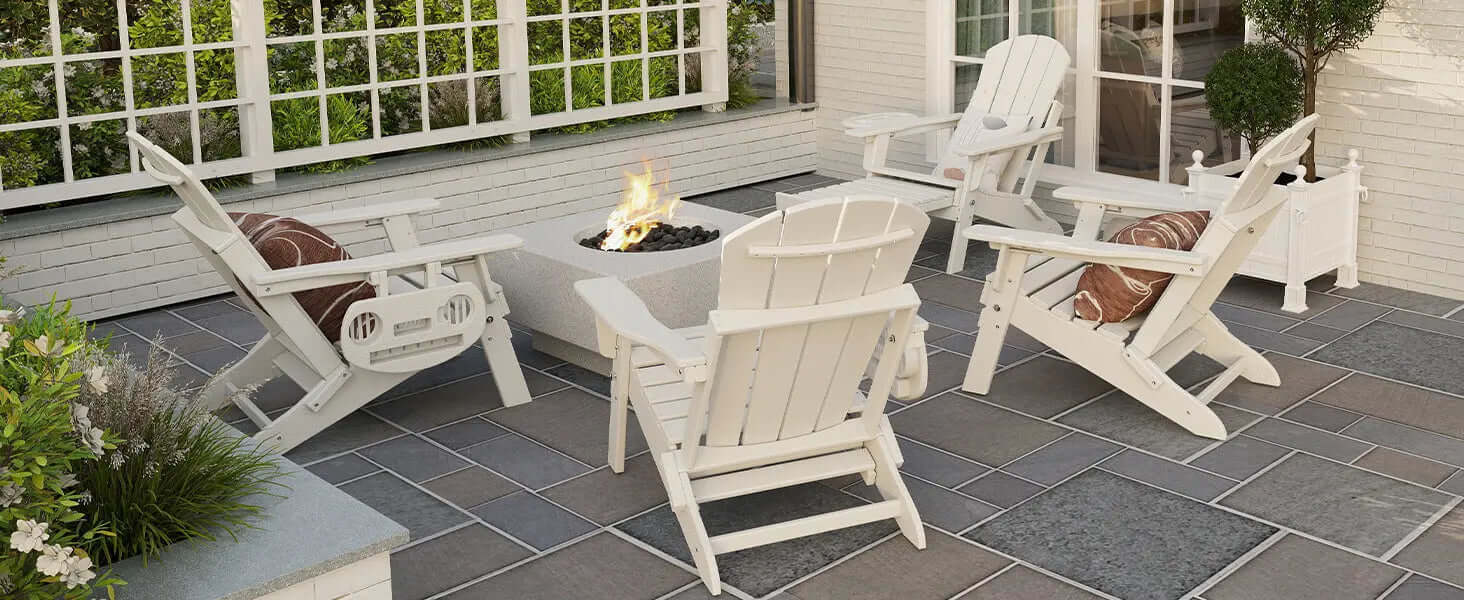
Placement matters more than most buyers realize. Radiant heat travels in a straight line and falls off quickly with distance, so a heater planted in the middle of an empty lawn is mostly heating the grass. Put it just outside the seating circle, angled inward, and everyone gets warm without anyone sitting on top of it. Wind is the enemy: a 10 mph breeze can cut effective range by half, so position the heater where a wall, fence, or hedge breaks the gusts. If your patio is fully open, consider the layout guidance in our fire pit seating guide, which covers the same wind-and-placement logic.
Pairing Outdoor Heaters with HDPE Furniture
This is the part most heater guides skip, and it is the part that determines whether your setup lasts one season or fifteen. Heaters and furniture interact in two directions: the heater radiates heat onto whatever is nearby, and cold weather stresses whatever is left outside. HDPE poly lumber handles both directions better than almost anything else on the market.
Heat Safety: HDPE Won't Warp, but Mind the Distance
HDPE is a dense, heat-tolerant plastic lumber, but "heat-tolerant" is not the same as "fireproof." Keep the heater's emitter at least 3 feet from any furniture surface, and never aim a swivel-arm heater directly down at a chair seat or tabletop for long stretches. Direct, close-range heat can soften the surface of even the sturdiest poly lumber over time. A few feet of clearance is all the maintenance this really demands.
The bigger advantage is what HDPE does not do. Wood furniture near a heater dries out, splits, and becomes a fire risk. Metal conducts heat until the armrests are genuinely painful to touch. HDPE stays warm but comfortable, and because it is solid-colored all the way through, a little heat exposure never leaves scorch marks or bleached spots the way stained wood does.
Moisture and Cold: Why HDPE Is the Ideal Cold-Weather Material
Heaters extend your season into the wet, freezing months — which is exactly when cheap outdoor furniture fails. Real wood absorbs water, freezes, thaws, and splits. Wicker and fabric trap moisture and grow mildew. HDPE poly lumber absorbs nothing, so it never swells, warps, or cracks through a freeze-thaw cycle. If you live somewhere with real winters, read our full breakdown on HDPE furniture in cold climates — it explains why this material survives conditions that destroy wood within a few seasons.

The practical upshot: you can leave HDPE seating out all winter, uncovered if you choose, and it will be ready the moment a mild evening tempts you back outside. A lightweight cover is enough for the pieces you do want to protect.
Building a Four-Season Patio Setup
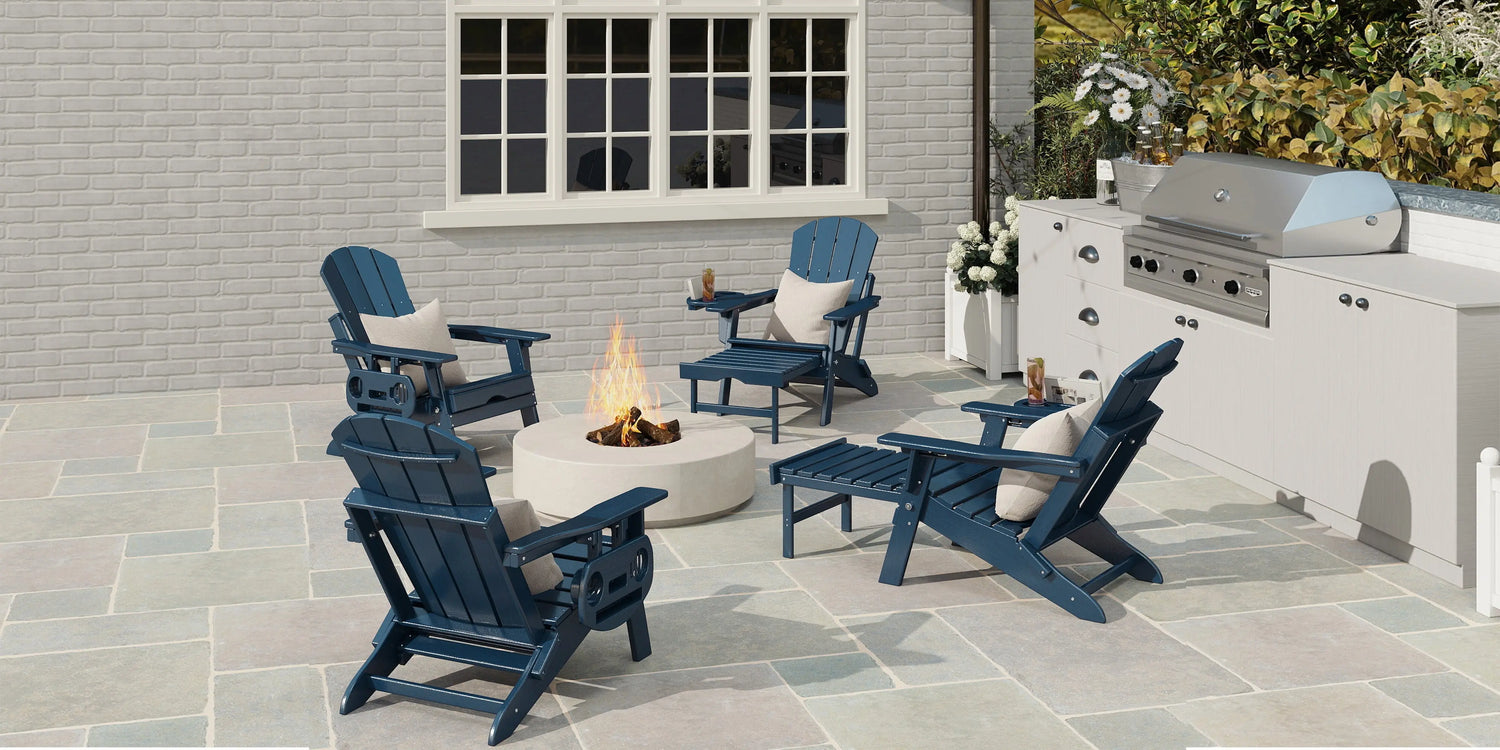
Put the pieces together and a true four-season patio is not complicated. Start with seating that is comfortable in every temperature — a HDPE lounge sofa set for conversation, or a pair of HDPE rocking chairs for slow evenings. Add a side table for drinks and a low shelf for gloves and blankets. Then place your heater just outside the seating circle, angled inward.
For entertaining, a HDPE dining table set becomes a useful cold-weather centerpiece once a heater is nearby — outdoor dinner parties in November are a small luxury most homeowners never think to have. Finish the space with a windbreak, and your patio becomes a room again, not a seasonal afterthought.
When the season finally does turn for good, do not haul everything into the garage out of habit. HDPE furniture does not need to be winterized the way wood does — a quick rinse and a cover on the pieces you care about most is plenty. Our winterizing checklist walks through the ten-minute version.
Frequently Asked Questions
What is the best type of outdoor heater for a patio?
For most open patios, a propane heater in the 40,000–48,000 BTU range is the best all-around choice because it throws heat up to 20 feet in a full circle and needs no electrical outlet. For covered, wind-protected spaces, an electric or infrared heater is quieter, cheaper to run, and vent-free.
Are propane patio heaters safe to use around HDPE furniture?
Yes, as long as you keep a clearance of at least 3 feet between the heater's emitter and any furniture surface. HDPE poly lumber won't ignite easily, but direct heat can soften its surface over time, so position the heater to one side rather than directly above a chair or table.
How many BTUs do I need for my outdoor space?
A good rule of thumb is roughly 40,000 BTUs for every 200 square feet of open patio. A 48,000 BTU heater covers about 200 square feet; a small tabletop unit (10,000–15,000 BTUs) is enough for two to four chairs pulled close together.
Can HDPE furniture handle cold weather and freeze-thaw cycles?
Absolutely. HDPE poly lumber is solid-colored plastic lumber that won't absorb water, so it never swells, cracks, or splinters in freezing temperatures. It's one of the most cold-hardy outdoor materials you can buy and needs no sealing or covering to survive winter.
Do patio heaters actually work in cold weather?
Yes, but they work by radiant heat, not by warming the air. In windy or wide-open conditions, much of the heat is lost, so a heater works best on a partially sheltered patio, with seating pulled within the heater's effective radius and heat-reflective surfaces nearby.

Mike Hartman
With over 20 years in outdoor construction and patio design, Mike has tested hundreds of outdoor furniture pieces in the brutal Texas sun. His philosophy: buy it once, maintain it never. When he is not writing, he is on his porch in Hill Country with a cold drink and a good book.
Read more from Mike →