

End of Summer Patio Deals: How to Spot Real Value vs Marketing Hype (2026)
Last Updated at: Mike HartmanEvery August, the same emails land in your inbox. "Final Markdown!" "Up to 70% Off!" "Clearance Event — This Weekend Only!" The end of summer patio furniture sale is a genuine seasonal ritual, and for good reason: retailers really do want to move last season's stock. But for every honest clearance deal, there is a fake markdown hiding behind a red tag and a countdown timer. Clearance season is prime time for both steals and scams, and it all comes down to telling a real discount from a manufactured one.
Quick Answer: A real end of summer patio furniture sale is a markdown below the item's normal street price, driven by inventory cycles — not a discount off an inflated anchor price. Before you buy any clearance patio furniture in 2026, verify the price history, judge the material and build quality in person, and skip floor models, discontinued lines, and anything missing hardware. Quality HDPE poly lumber rarely goes on deep clearance for a reason, so treat a 70%-off "deal" on premium furniture with healthy skepticism.
Why End-of-Summer Is Clearance Season
This one is not a trick. There is a real, structural reason prices fall in late August and September. Outdoor furniture is bulky and expensive to store. A patio set takes up warehouse space a retailer would rather fill with higher-margin fall and holiday merchandise, so holding summer stock through winter is a direct cost.
Layered on top of storage costs is the inventory cycle itself. Most stores finalize next year's product line in the late fall, so when next spring's models are already on the water from the factory, last year's colorways and configurations become a liability that must be cleared before the new floor sets arrive. The result is the one time of year when outdoor clearance deals are driven by real economics rather than marketing.
The catch is that this same season attracts the exact opposite — retailers who know customers expect discounts in August and fabricate "sales" to capture that demand. The calendar gives you a real window, but it does not tell you which tag is real.
The Psychology of a "Sale"
To spot fake sales, you first need to understand the three tools marketers use to make a full-price item look discounted. None of them are illegal, and all of them work on smart people.
Anchor Pricing
The anchor is the crossed-out "was" price, and it is the most common trick in the book. A chair is listed at $399, marked down from a "$699 MSRP" that the retailer never actually charged. The anchor makes $399 feel like a steal, even though $399 has been the going price all season. MSRP is a suggestion, not a record of what the item ever sold for. When you see a dramatic slash, ask not "how much did I save?" but "was that reference price ever real?"
Artificial Urgency
"Only 3 left!" "Sale ends tonight!" "Low stock — 2 people are viewing this." Countdown timers and scarcity badges are designed to short-circuit the comparison-shopping step. If a deal is truly good, it will still be good after you have opened a second tab and checked the price elsewhere. The pressure to buy now is a tell, not a feature. Legitimate clearance moves on inventory cycles measured in weeks, not hours, so an expiring-timer discount usually signals the price, not the stock, is what would not survive scrutiny.
Fake Markdowns
The most brazen version is the price that was quietly raised in July so it could be "cut" in August. Without price history, a 40%-off tag can simply be the original price with a bigger number printed next to it. This is why the most useful clearance-season skill is knowing what an item actually costs elsewhere — a fake markdown is invisible without a baseline.
How to Verify a Real Discount
Verifying a patio furniture sale is a ten-minute job, and it is the difference between a bargain and an overpay. Here is the process I use.
Check Price History
Free price-tracking tools keep a running log of what an item has sold for over the past 90 days to a year. Search the exact model name or SKU and look at the chart. If the "sale" price is lower than anything the item has sold for in the last six months, you are looking at a genuine discount. If the line has been flat at $399 for a year and the tag says "was $799," walk away. Price history turns vague suspicion into a yes-or-no answer.
Know MSRP vs Street Price
MSRP is the manufacturer's suggested retail price, and it is often set high precisely so retailers can advertise discounts off it. What matters is the street price — what the item actually sells for across the market. Search the model number and note the price range from three or four sellers. A real deal beats the low end of that range, not merely the highest MSRP you can find.
Cross-Check Retailers
Never buy a clearance item from a single source without checking at least two others. Big-box home stores, specialty patio retailers, and the manufacturer's own site often carry the same or comparable models, and their prices give you the baseline you need. A genuine end of summer patio furniture sale is roughly consistent across sellers because the inventory pressure is market-wide. When one retailer's "deal" is dramatically better than everyone else's, that gap is usually the size of the lie.
Judging Material Quality During Clearance
A clearance tag does not change what the furniture is made of. A cheap chair is still a cheap chair at 60% off, and if it fails in two seasons you have not saved money — you have just bought a landfill item more slowly. The single most important inspection you can make during an outdoor clearance deal is the material.
Start with the frame. Wood needs to be a genuinely rot-resistant species — teak, cedar, or white oak — and even then it needs annual sealing. Softwoods like pine are a warning sign at any price. Powder-coated aluminum is light and rust-resistant but watch the gauge; thin aluminum flexes and dents. Wrought iron and steel are strong but rust unless the coating and joints stay sealed.
Then look at what will touch you and the weather. Cushions on clearance are often the first thing to be sun-faded or mildewed, so unzip a cover and check the foam. And if the piece is plastic, ask what kind — cheap polystyrene resin gets brittle and chalky after one summer of UV exposure, which is exactly why it is always on sale. Materials that do not degrade point you toward HDPE poly lumber, which I will get to below. For a deeper read, see our breakdown of HDPE versus cheap plastic resin.
Clearance Red Flags: Floor Models, Discontinued Lines, Missing Hardware
Some clearance inventory is discounted for honest reasons — last season's color, a slow seller, a warehouse that needs space. Other inventory is discounted because something is wrong with it. Here are the three red flags that should make you pause.
Floor Models
A floor model has spent an entire season outdoors in the sun, rain, and showroom traffic. For HDPE or powder-coated aluminum that is often fine, since those materials are built for exactly that exposure. But for wood that has gone grey and checked, or fabric that has faded and thinned, the discount is compensation for lost lifespan, not a bonus. If you buy a floor model, inspect it closely and do not pay more than the visible wear justifies.
Discontinued Lines
A discontinued line is not automatically a bad buy, but it carries a hidden cost: when the collection is gone, so are the matching pieces and replacement parts. If you buy a discounted sectional and want to add a matching chair next year, you will likely be out of luck. Discontinued is fine when you are buying a complete, self-contained set and you accept that you cannot expand it. It is a trap when you are buying the first piece of a set you planned to grow.
Missing Hardware
This is the clearance red flag people most often miss. Bolts, washers, caps, and assembly tools go missing from open-box and floor-model inventory all the time, and a "great deal" that is missing a proprietary fastener becomes a project you may never finish. Before you hand over money, open the box or ask the salesperson to confirm the hardware pack is sealed and complete. For HDPE furniture, also confirm the stainless-steel hardware is included — quality brands use it specifically so it will not rust, and off-brand substitutes will not hold up the same way. For a full inspection checklist, see our guide on judging HDPE furniture quality.
Where HDPE Fits: Why Quality Furniture Rarely Goes on Deep Clearance
If you have ever wondered why premium patio furniture never seems to show up in the 70%-off bin, the answer is the material. HDPE poly lumber — the dense, recycled-plastic lumber used in high-end outdoor furniture — does not rot, warp, splinter, or fade the way wood and cheap resin do. A retailer holding HDPE inventory has no seasonal clock to beat, because the product does not expire the way a pine chair with a summer-only coating does.
That is why real HDPE rarely sees the deep discounts that flood the clearance season. The seller is not desperate to move it, and customers are willing to pay for a piece that will last 20-plus years. When HDPE does go on sale, it is usually a modest, honest markdown off a stable street price — not a theatrical slash from a fake anchor. This is the clearest signal in the clearance game: the items with the biggest percentage discounts are usually the ones with the least value, and the items that hold their price are the ones worth owning.

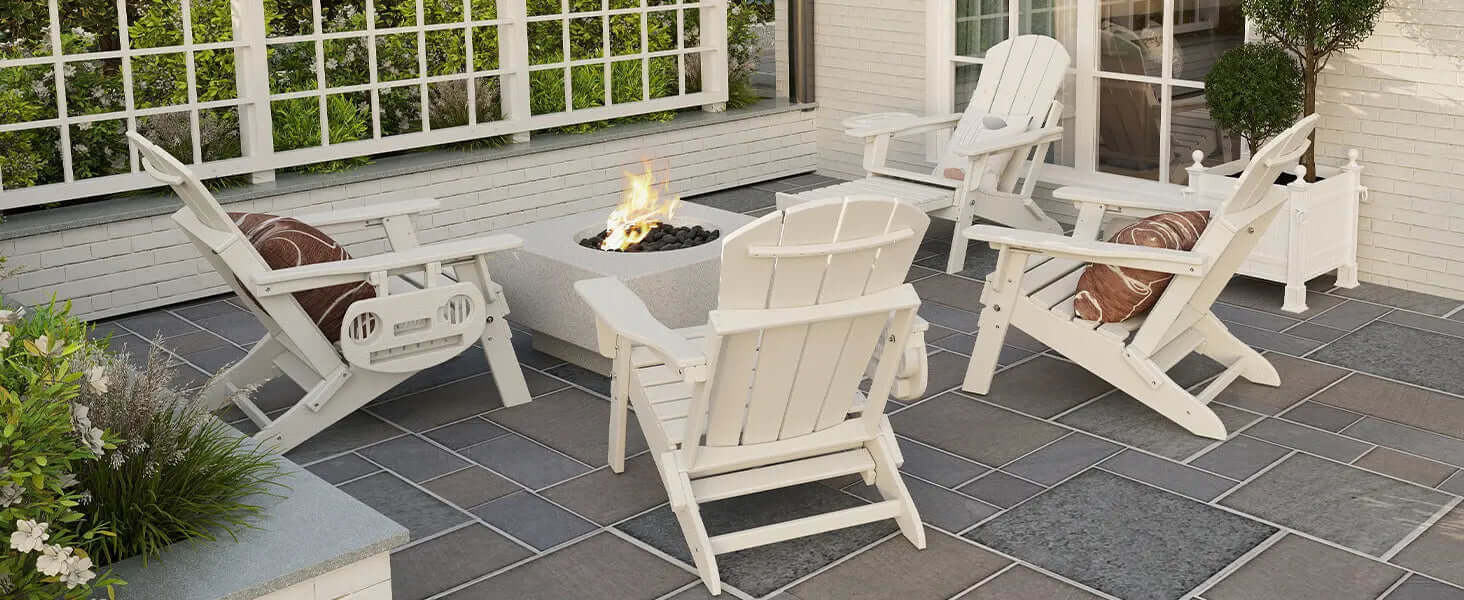
A lounge set like this is a good illustration. It is not the cheapest option in the clearance aisle, and it never will be. But amortized over two decades of zero maintenance, its cost per season beats a $199 resin set that needs replacing every two or three years. If you want the full math, our piece on HDPE cost versus value breaks down the long-term numbers. The short version: a real deal is measured in years of service, not in the size of the percentage off.

A Smart Buyer's End-of-Summer Checklist
Bring it all together before you swipe the card. Here is the checklist I run every clearance piece through:
- Verify the price. Check price history and cross-check at least two other sellers. A real discount beats the street price, not a made-up MSRP.
- Ignore the timer. Genuine clearance does not expire in two hours. If urgency is the sales pitch, slow down.
- Inspect the material. Confirm the frame is a durable material — rot-resistant hardwood, thick powder-coated aluminum, or HDPE — not cheap resin or thin softwood.
- Check the hardware. Make sure the hardware pack is present and stainless steel, and that nothing is missing or substituted.
- Look for floor-model wear. Faded cushions, grey wood, and scuffed frames mean the discount is paying for lost lifespan.
- Confirm the line is not discontinued unless you are buying a complete set you will never expand.
- Apply the long-term test. Ask what the piece will cost per year of service. A $199 chair that lasts two years costs more per year than a $299 HDPE chair that lasts twenty.
Run a piece through that list and the outcome is usually obvious. Most "clearance" fails on the first two checks alone, which means the deal was never real.
FAQ
When is the best time to buy outdoor furniture on clearance?
The best window runs from late August through early October. Retailers are clearing summer inventory to make room for fall and holiday stock, and Labor Day weekend plus the final weeks of September tend to carry the deepest markdowns. The tradeoff is selection — popular finishes and sizes sell out by mid-August, so shop early for choice and late for price.
How can I tell if a patio furniture sale is real?
Check the item's price history and compare the sale price against the same model at two or more other retailers. A genuine discount sits below the item's typical street price, not below a manufactured MSRP. If the reference price was never actually charged, or the item is never in stock at that price, the markdown is marketing rather than savings.
Why are end-of-summer prices lower?
Outdoor furniture is bulky and costly to store, so retailers want it out of the warehouse before the slower fall and winter seasons. Carrying costs, limited showroom space, and the arrival of next year's inventory all push stores to discount summer stock heavily. It is a real inventory-cycle discount, which is why legitimate deals do exist this time of year.
Should I buy clearance outdoor furniture?
Yes, when you verify the discount is real and the piece is built to last. Clearance is a smart way to save on quality furniture you would buy anyway. Skip it when the item is a worn floor model, a discontinued line you cannot get parts for, or a heavily discounted piece made from materials that will fail — a cheap chair that breaks in two years is not a bargain.
What should I check before buying discounted patio furniture?
Inspect the frame material, joinery, and hardware. Confirm all fasteners and assembly parts are present, the frame has no cracks, warping, or rust, and cushions and finishes are intact. Verify the model is still supported with replacement parts, and check the final price against price history. For HDPE furniture, confirm the lumber is thick, colorfast, and backed by a real warranty.
Does HDPE furniture ever go on clearance?
Rarely, and almost never at the deep 60-70% discounts you see on wood, resin, or metal. HDPE poly lumber holds its value because it does not rot, warp, or fade, so retailers feel no pressure to clear it. When HDPE does go on sale, the markdown is usually a modest 10-20% off an honest street price — not a fake anchor discount.

Mike Hartman
With over 20 years in outdoor construction and patio design, Mike has tested hundreds of outdoor furniture pieces in the brutal Texas sun. His philosophy: buy it once, maintain it never. When he is not writing, he is on his porch in Hill Country with a cold drink and a good book.
Read more from Mike →