

HDPE vs Cheap Plastic: Is All-Weather Resin a Lie? (2026)
Last Updated at: Mike HartmanWalk into any big-box store between March and June and you will see rows of outdoor chairs labeled "all-weather resin." The name sounds reassuring. Resin. Premium. Engineered. Weatherproof. You picture something substantial — dense, durable, built for seasons of sun and rain. Then you pick one up. It weighs 12 pounds. The armrests flex when you squeeze them. The screws look like they came from a hardware store bargain bin. And a little voice in your head says: this is just plastic, isn't it?
You are not wrong. The term "resin" in outdoor furniture is one of the most abused words in home goods marketing. It gets slapped onto everything from genuine high-density polyethylene (HDPE) poly lumber to the thinnest blow-molded polypropylene chair that will snap its first summer in direct sun. The gap between what "all-weather resin" promises and what it delivers is where most outdoor furniture buyers get burned.
So let's cut through the marketing. Here is exactly what separates real HDPE poly lumber from the cheap plastic pretending to be resin — and why it matters every single time you sit down outside.
Quick Answer: Genuine HDPE poly lumber is solid, heavy, UV-stable material made from recycled plastics and built to last 20+ years outdoors. Cheap "resin" furniture is typically hollow blow-molded plastic with thin walls, surface-only color, and hardware that rusts. The weight difference tells you almost everything: a real HDPE Adirondack chair weighs 35-45 lbs. A resin imitation weighs 12-18 lbs. If it feels light enough to toss with one hand, it is not real poly lumber.
What "All-Weather Resin" Actually Means
Here is the uncomfortable truth: "all-weather resin" means nothing specific. It is not a regulated term. It is not a material standard. It is a marketing phrase, and manufacturers use it to describe everything from premium HDPE to recycled polypropylene to injection-molded polystyrene blended with fillers.
The word "resin" itself simply refers to any synthetic polymer compound — which is to say, plastic. All of it. HDPE is plastic. Polypropylene is plastic. Polystyrene is plastic. The $200 chair is plastic. The $50 chair is plastic. What separates them is not whether they are plastic, but what kind, how thick, how it is manufactured, and what stabilizers are baked in.
When a manufacturer labels something "all-weather resin" without specifying the polymer type, assume polypropylene or a polypropylene blend with fillers. Polypropylene is cheaper than HDPE, lighter, less UV-resistant, and far less durable in outdoor conditions. It is not inherently evil — polypropylene has legitimate uses — but when it is molded thin and hollow and sold as outdoor furniture, it fails predictably.
Real HDPE outdoor furniture is almost always labeled specifically as HDPE, poly lumber, or recycled poly lumber. Manufacturers who use genuine HDPE are proud of it because it costs more and performs dramatically better. If a product description dances around the material — "durable resin construction," "weather-resistant composite," "premium synthetic material" — without ever saying HDPE or poly lumber, you are looking at something else.
HDPE vs Resin: 5 Key Differences
1. Weight and Density
Pick them up side by side and the difference is immediate. Genuine HDPE poly lumber has a density of roughly 0.95 g/cm³ and is manufactured in solid boards typically 1/2 inch to 1 inch thick. A full-size HDPE Adirondack chair weighs between 35 and 45 pounds. You feel it when you lift it — substantial, planted, not going anywhere in a gust of wind.
Cheap resin chairs use blow-molded or injection-molded construction with wall thicknesses often under 3 millimeters. An entire chair weighs 12 to 18 pounds. A strong breeze can send it tumbling across the patio. The weight difference is not just about stability — it is a proxy for material volume, which is a proxy for durability. More material means more UV stabilizer distributed throughout, more structural integrity, and more resistance to cracking.
2. UV Resistance and Color Retention
This is where the manufacturing process makes all the difference. Genuine HDPE poly lumber has UV inhibitors and pigments mixed through the entire board during extrusion. The color is not painted on; it is the material. Scratch it with a key, and the same color shows underneath. After 10 years in direct sun, genuine HDPE may lighten one or two shades. But it will not chalk, peel, or turn white.
Cheap resin furniture typically has UV protection applied only to the surface layer — a coating or a thin co-extruded skin. Once that surface degrades (which happens fast in intense sun), the underlying material has no protection. It chalks. It fades unevenly. It develops that sad, streaky white residue that says "this chair gave up." Within 2-3 summers of direct sun, a cheap resin chair looks significantly worse than when you bought it. A genuine HDPE chair looks essentially the same.
3. Fastener and Hardware Quality
Look at the screws. It sounds trivial — until a rusted bolt stains your deck and the armrest falls off. Genuine HDPE furniture uses marine-grade stainless steel fasteners, typically 304 or 316 grade, designed for saltwater environments. The hardware is thick, the threads are clean, and the bolts are sized for structural loads, not just assembly.
Cheap resin furniture uses zinc-plated steel or, worse, plain carbon steel with a thin anti-corrosion coating. These rust within one season in humid climates and within one month at the beach. The screws are often undersized because the thin plastic walls cannot support deeper threading. When a bolt pulls through or rusts through, the chair is effectively done — repairing thin-walled hollow plastic is nearly impossible.
4. Structural Design and Comfort
Real HDPE furniture is built like outdoor cabinetry — solid boards joined with structural screws into a frame that distributes weight evenly. It does not flex when you sit. The armrests do not bow under pressure. The seat feels planted. This contributes to comfort in a way that is hard to describe until you experience it: the chair supports you instead of giving under you.
Cheap resin chairs rely on the geometry of thin-walled plastic to support weight. They flex. They creak. The armrests bend visibly when someone leans on them to stand up. That flexing is not just unpleasant — it is the mechanism of failure. Every flex stresses the material at its weakest points. Combined with UV embrittlement, flexing turns a hairline crack into a full structural split.
5. Warranty
Warranty terms are the single most honest signal in outdoor furniture because the manufacturer has money on the line. Genuine HDPE manufacturers offer 12-year, 15-year, or even 20-year residential warranties — and limited lifetime warranties on some components. They can do this because they know the material will last.
Cheap resin furniture warranties range from 90 days to 2 years. Some brands bury the warranty terms entirely or make them so restrictive (excludes sun damage, excludes normal wear, excludes coastal environments) that they are functionally worthless. If a manufacturer will not stand behind their product for at least a decade, they are telling you exactly how long they expect it to last. Believe them.
The Hollow Plastic Problem: Why Cheap Chairs Crack in Year 2
There is a specific failure mode that kills most cheap outdoor chairs, and it is worth understanding because it is utterly predictable once you know the physics.
Blow-molded and thin-wall injection-molded chairs are hollow. The walls are typically 2 to 4 millimeters thick — about the thickness of a plastic milk jug. The chair holds its shape through geometry, not material volume. Every time someone sits, the walls flex. Every night, the material contracts as it cools. Every day, it expands in the sun. This cycle of flexing and thermal expansion creates stress concentrations at corners, joints, and screw holes.
Meanwhile, UV radiation is breaking down the polymer chains at the molecular level. Polyethylene and polypropylene are long chains of carbon and hydrogen atoms. UV photons have enough energy to break those bonds, shortening the chains and making the material progressively more brittle. In thick, solid HDPE with UV stabilizers distributed throughout, this degradation is slow and shallow. In thin, hollow resin with surface-only UV protection, it is fast and catastrophic.
Here is the sequence: Year one, the chair looks fine. Surface UV protection is intact. Year two, the protective layer is degrading and UV is reaching the base polymer. The material is becoming brittle but still holds. Someone leans back a little harder than usual, or a guest sits down heavily, or the wind catches the chair and it tips over. The flex at a stress point exceeds the now-brittle material's tolerance. A crack forms — small, maybe invisible. Water gets in. Freeze-thaw cycles widen it. By year three, the armrest has split, the seat has a visible crack, and the chair is on its way to the landfill.
This is not a defect. It is the expected behavior of thin-walled plastic exposed to outdoor conditions. The chair was designed to look good in the store and survive long enough to clear the warranty period. It did exactly what it was engineered to do.
Real HDPE: How Poly Lumber Is Made
Genuine HDPE poly lumber starts with something most people throw away: milk jugs, detergent bottles, and shampoo containers. These are collected, cleaned, shredded into flakes, and then melted and extruded under high pressure into solid dimensional boards — typically 1x4, 1x6, 2x4, and 2x6 profiles similar to wood lumber.
During extrusion, several things happen that cheap plastic manufacturing skips. UV inhibitors are blended into the molten HDPE, not sprayed on afterward. Pigments are mixed through the entire melt, so the color is the material — not a coating. The extrusion pressure and cooling rate are tightly controlled to produce consistent density and prevent internal voids or stress points. The resulting board is solid all the way through, with the same color, density, and UV resistance at the core as at the surface.
These boards are then cut, shaped, and assembled into furniture using the same woodworking techniques you would use with cedar or teak — routing, drilling, counter-sinking, and fastening with stainless steel hardware. The result is a piece of furniture with the workability of wood and the weather resistance of plastic, without the downsides of either. It will not rot like wood. It will not rust like metal. It will not crack and fade like cheap plastic. And it requires exactly zero maintenance: no staining, no sealing, no sanding, no covering. Hose it off once a year if you feel ambitious.
The recycled content is not just a marketing point — though it is a good one. HDPE poly lumber diverts post-consumer plastic from landfills and oceans. A single Adirondack chair typically contains the equivalent of 250-300 recycled milk jugs. That is real material, real weight, and real durability — not a thin shell of virgin plastic molded to look substantial from a distance.
How to Spot Fake "Resin" Before You Buy
You cannot always visit a showroom, but you can still separate genuine HDPE from imitation resin with a few checks — even when shopping online.
The weight test. Find the product weight in the specifications. A full-size HDPE Adirondack chair should weigh at least 35 pounds. A dining armchair should be 25-30 pounds. If the listed weight is under 20 pounds for a full-size chair, it is hollow or thin-walled — not solid HDPE. If the weight is not listed anywhere, that is itself a red flag.
The screw inspection. Look at product photos showing assembly details or close-ups of hardware. Genuine HDPE furniture uses visible stainless steel screws with clean, heavy heads. If the hardware looks like generic silver screws you would find in a home center blister pack, or if the screws are hidden behind plastic caps in a way that suggests the manufacturer does not want you looking at them, be skeptical.
The warranty check. Look up the warranty before you buy — not just the length, but the terms. A legitimate HDPE warranty covers fading, cracking, splitting, and structural failure for at least 10-12 years in residential use. It does not exclude sun damage (because HDPE is designed for sun). It does not exclude coastal environments (because marine-grade hardware is standard). If the warranty is hard to find, requires you to register within 30 days and keep your receipt forever, or reads like a list of things not covered, the manufacturer is protecting themselves from the predictable failure of their product.
The material disclosure. Read the product description carefully. Does it say "HDPE" or "high-density polyethylene" or "poly lumber" specifically? Or does it say "resin," "all-weather material," "durable synthetic," or "composite"? Specificity is honesty. Vagueness is evasion. A manufacturer using genuine HDPE will tell you because it is a selling point. A manufacturer using cheap polypropylene or polystyrene will call it "premium resin" and hope you do not ask follow-up questions.
The underside photo. If you can find a photo of the underside of the chair — on a review site, in customer images, or in the product gallery — look at it. Solid HDPE has a consistent, dense surface. Hollow blow-molded chairs have visible cavities, thin walls, and sometimes reinforcing ribs that look like the inside of a cooler. That is exactly what they are: hollow plastic shells shaped like furniture.
Price Comparison: $80 Resin Chair vs $200 HDPE Chair Over 5 Years
Let's run the numbers. They tell a story that the sticker price does not.
A cheap resin Adirondack-style folding chair costs about $80 at a big-box retailer. It weighs 14 pounds. The warranty is one year. In direct sun with regular use, it will fade significantly by the end of year two, develop creaking and flex by year three, and likely crack at a stress point — an armrest, a seat slat, a back joint — sometime in year four. Replace it, and you have spent $160. Replace it again in year eight, and you are at $240.
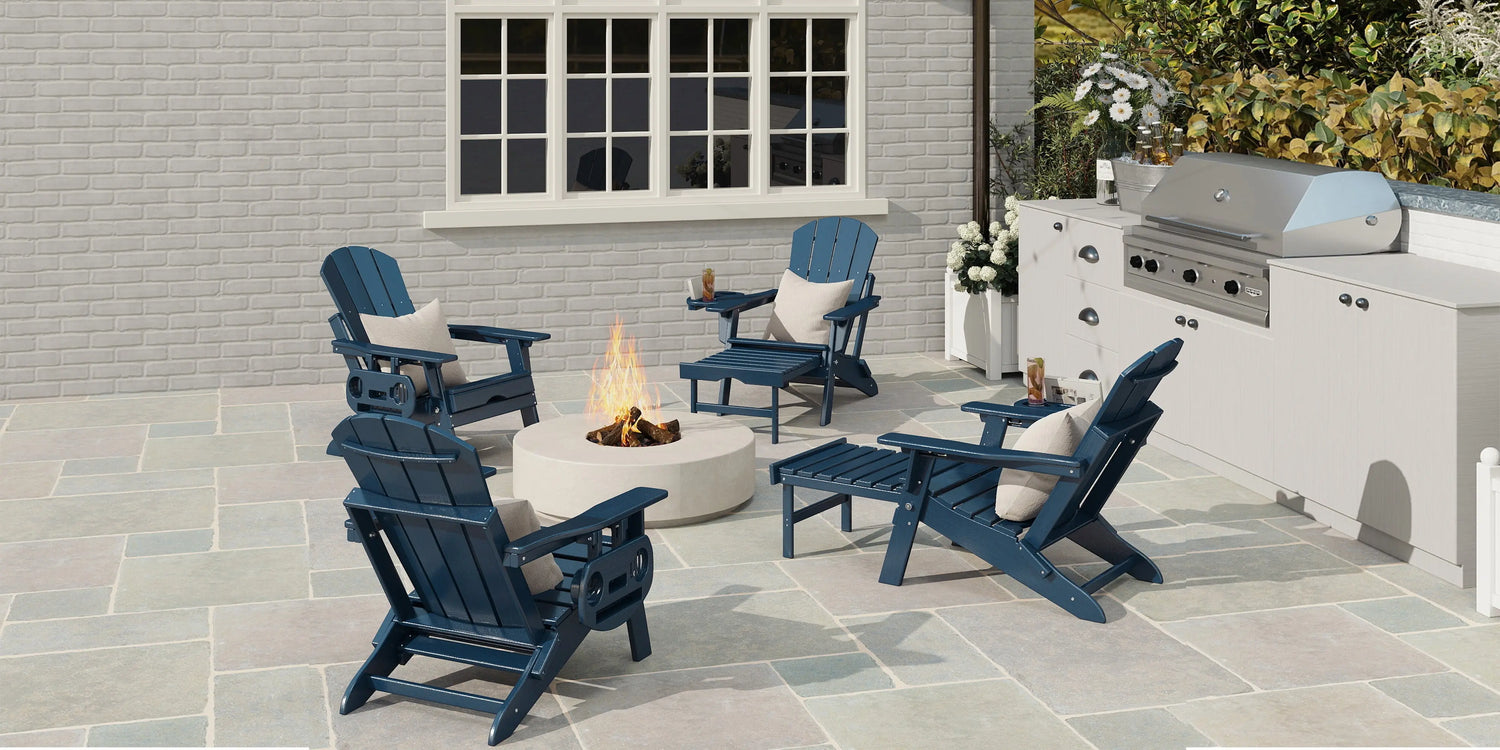
A genuine HDPE poly lumber folding Adirondack chair — like the Foowin Classic Folding Adirondack Chair — costs roughly $200. It weighs 38 pounds. The warranty runs 12 to 20 years. After five years, it looks essentially the same as day one. After ten years, it might be one shade lighter. After twenty years, it is still structurally sound and perfectly usable. Total five-year cost: $200. Total twenty-year cost: $200 — plus zero hours of maintenance.
The cheap chair appears to save you $120 at checkout. Over five years, it actually costs more. Over a decade, it costs significantly more — in money, in time spent shopping for replacements, in the frustration of sitting in furniture that looks and feels degraded, and in the environmental cost of sending multiple chairs to a landfill instead of one chair made from recycled material that will outlast you.
This math holds across every outdoor furniture category — dining chairs, loungers, benches, deep seating. The upfront savings on cheap resin evaporate the moment you buy the second one.
Shop Genuine HDPE Outdoor Furniture →


FAQ
What is the difference between HDPE and resin outdoor furniture?
HDPE is solid, dense poly lumber made from recycled milk jugs and detergent bottles, with UV stabilizers and color molded through the entire board. Cheap "resin" furniture uses hollow blow-molded construction with thin walls, surface-only color that fades, and zinc-plated screws that rust within one season. The simplest test: a real HDPE Adirondack chair weighs 35-45 pounds. A resin imitation weighs 12-18 pounds.
Is poly lumber really just plastic?
Technically yes — but calling it "just plastic" is like calling a hardwood deck "just wood." Real poly lumber is solid, dense material extruded under high pressure with UV inhibitors mixed throughout. Cheap resin is thin, hollow, and brittle. A single HDPE Adirondack chair contains roughly 250-300 recycled milk jugs transformed into solid dimensional boards. The word "plastic" describes the chemical family, not the engineering.
How can I tell if outdoor furniture is real HDPE or cheap plastic?
Pick it up — HDPE is heavy (35-45 lbs for an Adirondack chair). Check the underside: HDPE is solid throughout; cheap resin is hollow with visible thin walls. Inspect the fasteners: real HDPE uses marine-grade stainless steel (304 or 316 grade). Scratch test a hidden spot: HDPE shows the same color underneath. Check the warranty: genuine HDPE comes with 12-20 year residential coverage. If it says only "resin" without specifying HDPE or poly lumber, assume it is something less durable.
How long does HDPE furniture last compared to resin?
Genuine HDPE lasts 20-25+ years with zero maintenance. Cheap resin averages 2-5 years before cracking, fading, or structural failure. A 5-year-old resin chair looks degraded. A 15-year-old HDPE chair looks nearly new. This gap is exactly why HDPE warranties run 12-20 years and resin warranties top out at 2.
Why do some resin chairs crack after 2 years?
Hollow blow-molded construction with walls under 3mm, combined with UV degradation, creates a predictable failure. UV breaks down polymer chains, making the plastic brittle. Every time someone sits, the thin walls flex. Brittle material plus repeated flexing equals cracks — usually at armrest joints or screw holes. Temperature cycling and water intrusion accelerate the damage. Real HDPE avoids this entirely: solid boards do not flex, UV stabilizers run through the full thickness, and there is no surface layer to wear through.
Is HDPE worth the higher price?
Over 10 years, HDPE is dramatically cheaper. A $200 HDPE chair lasting 20 years costs $10 per year. An $80 resin chair replaced every 3 years costs $26.67 per year. By year six, you have spent $160 on resin versus $200 on HDPE that still looks new. Beyond cost: HDPE is heavier, more comfortable, fade-proof, and maintenance-free. The upfront premium is real, but the lifetime cost is lower and every single day you use it, the experience is better. If you are furnishing a space you actually use, HDPE pays for itself.
Related reads: For a broader comparison across materials, see our HDPE vs Wood vs Metal guide. If you are weighing the upfront cost, our HDPE cost vs value analysis breaks down the lifetime economics. And for a deep dive into the material itself, read our complete HDPE material guide.

Mike Hartman
With over 20 years in outdoor construction and patio design, Mike has tested hundreds of outdoor furniture pieces in the brutal Texas sun. His philosophy: buy it once, maintain it never. When he is not writing, he is on his porch in Hill Country with a cold drink and a good book.
Read more from Mike →