

What Makes Adirondack Chairs Special? History, Design and Why Everyone Loves Them (2026)
Last Updated at: Mike HartmanQuick Answer: What Makes Adirondack Chairs So Special?
Quick Answer: Adirondack chairs are special because of their signature sloped seat and high back, which create a naturally reclined sitting position that's more comfortable than any upright outdoor chair. Originating in 1903 in the Adirondack Mountains of New York, the design has outlasted every furniture trend for over 120 years. The wide armrests — originally designed to hold a drink and a plate — remain one of the most practical features in outdoor furniture. Modern HDPE versions of this classic design give you all the comfort and character without the annual sanding, painting, and splinter-checking that wooden originals required.
The Origin Story: Why Are They Called Adirondack Chairs?
In 1903, a man named Thomas Lee was vacationing with his family in Westport, New York, in the heart of the Adirondack Mountains. He needed outdoor chairs for the summer cottage, but nothing available at the time was comfortable enough. So Lee — who had no formal design training — started experimenting with boards nailed together at different angles.
He tested his prototypes on family members. The winner: a chair with a dramatically angled seat, a tall slatted back, and wide flat armrests. It let you sit back naturally, rest your arms comfortably, and — crucially — didn't tip over on uneven ground.
Lee shared the design with a local carpenter named Harry Bunnell, who recognized its commercial potential. Bunnell filed a patent for the "Westport chair" in 1904 and began producing them for sale. Lee never saw a dime. The chairs became known as "Adirondack chairs" because of their mountain origin, not because of any official naming — the Adirondack region simply lent its name to the most comfortable outdoor chair ever designed.
The original chairs were made from hemlock, painted dark green or brown. They had 11 flat boards for the back and a single wide board for the seat. The design was simple enough that anyone with basic carpentry skills could build one, which is exactly what happened — Adirondack chairs spread across America through DIY plans in magazines and woodworking books.
The Ergonomic Genius Behind the Design
The Adirondack chair's comfort isn't an accident — it's the result of specific design decisions that were decades ahead of ergonomic science.
The Seat Angle: 105-110 Degrees of Pure Relief
Standard outdoor chairs keep you at 90 degrees — bolt upright, like sitting at a desk. Adirondack chairs tilt the seat backward by 10-15 degrees and angle the backrest to about 105-110 degrees from the seat. This combination naturally shifts your center of gravity backward, taking pressure off your lower spine. Your body weight distributes across your entire back rather than concentrating on your tailbone.
This angle is also why Adirondack chairs feel so good for stargazing. Your head naturally tilts back just enough to look up without straining your neck. Try that in a standard upright chair and you'll be rubbing your neck within five minutes.
The Wide Armrests: The Feature That Defines the Category
Thomas Lee originally designed the wide armrests for a practical reason: they hold a plate of food and a drink simultaneously. In the era before outdoor coffee tables became standard, the chair itself had to serve as a surface.
This turned out to be the Adirondack chair's killer feature. The 5-6 inch wide armrests comfortably hold a coffee mug, a paperback, a phone, or a small plate. Modern versions with built-in cup holders take this further — you can set down a glass without worrying about condensation rings or wind knocking it over.
The Tall Slatted Back: Support With Airflow
At 32-38 inches tall, the Adirondack back supports your head and shoulders — something low-backed chairs can't do. The individual slats have small gaps between them, which serves two purposes: it reduces wind resistance (so the chair doesn't blow over in storms), and it allows air circulation behind your back on hot days. A solid back panel would trap heat and sweat.
Why the Design Has Survived 120 Years
Furniture trends come and go. Victorian parlor chairs, mid-century modern, inflatable plastic — all had their moment. The Adirondack chair has outlasted every one of them. Here's why:
It Works Without Explanation
Nobody needs to be taught how to sit in an Adirondack chair. You see one, you instinctively know what to do. The wide arms invite you to set down your drink. The angled seat pulls you into relaxation mode. It's furniture that communicates its purpose without words.
It Looks Better With Age — In Modern Materials
Wooden Adirondack chairs have a romance to their weathering — the silver-gray patina of aged cedar, the character of checking and grain. But that romance comes with splinters, structural weakening, and eventual replacement. HDPE Adirondack chairs solved this: they maintain the classic silhouette forever, without any of the decay. The color is consistent, the surface stays smooth, and the chair looks the same at year 15 as it did on day one.
It Bridges Style Eras
An Adirondack chair looks appropriate next to a rustic log cabin, a modern glass-walled house, a coastal cottage, or a suburban ranch. The design is specific enough to be recognizable but simple enough to not clash with surrounding architecture. That's rare in furniture — most iconic designs (Eames lounge chair, Barcelona chair) look out of place outside their intended context. The Adirondack chair fits everywhere.
The Modern Evolution: HDPE vs Traditional Wood
The biggest change to Adirondack chairs in the last 20 years isn't the design — it's the material.
What Wood Gives You
Wooden Adirondack chairs offer natural grain patterns that vary from chair to chair. Teak versions develop a distinguished silver-gray patina. Cedar smells amazing when new. These sensory qualities matter to people who value authenticity and natural materials above all else.
The trade-off: wood requires annual maintenance. Sand down splinters in spring. Re-stain or re-oil before summer. Tighten hardware that's loosened as wood expands and contracts. Even with diligent care, wooden chairs typically last 8-15 years before structural issues appear.
What HDPE Gives You
HDPE Adirondack chairs give you the exact same silhouette — same seat angle, same wide arms, same tall back — in a material that doesn't degrade. No splinters ever. No paint or stain required ever. The color is consistent throughout the material, so a scratch reveals the same color underneath. Clean with a garden hose. That's the entire care routine.
HDPE chairs weigh more than wood (about 40-50 pounds per chair vs 25-35 for cedar), which is actually an advantage — they won't blow over in strong winds. In coastal areas with salt spray, in humid regions with constant moisture, or in sunny climates with intense UV exposure, HDPE dramatically outperforms wood.
How to Style Adirondack Chairs in Different Settings

Lake House or Beach Cottage
Line up four to six Adirondacks facing the water. Add a low table between pairs for drinks. White, navy, or sky blue chairs against a waterfront backdrop create the classic summer look. The chairs handle salt spray and sand without complaint — hose them off after a week of beach traffic and they're ready for the next round of guests.
Fire Pit Circle
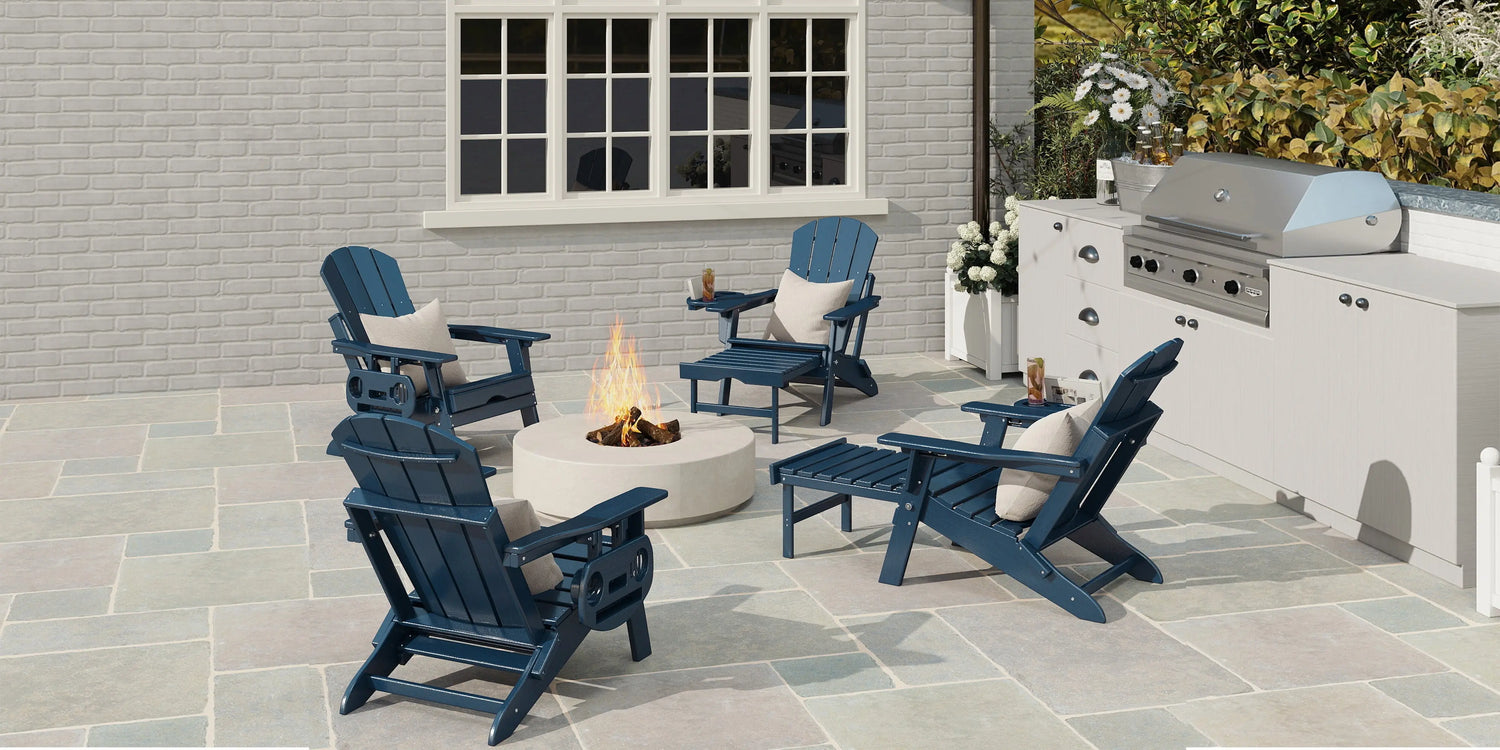
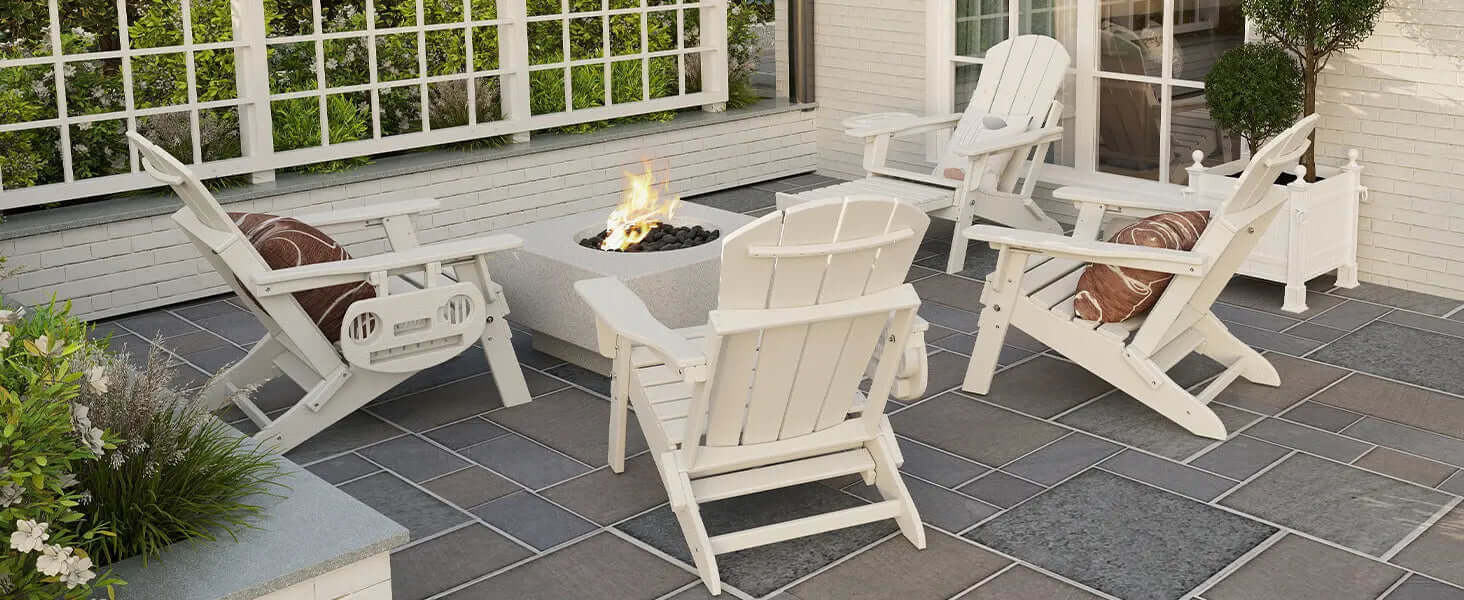
Arrange six to eight Adirondack chairs in a circle around a fire pit, leaving about 5-6 feet between the pit edge and the chair fronts. The reclined angle is perfect for fire-gazing — your head naturally tilts slightly upward toward the flames and stars. Read our complete fire pit seating guide for arrangement tips.
Front Porch Statement
A pair of matching Adirondack chairs on a front porch signals "this is a home where people slow down and enjoy themselves." Add a small side table between them for coffee or lemonade. Choose a color that contrasts with your house color — black chairs against white siding, white chairs against dark brick.
Garden Reading Nook
Place a single Adirondack chair in a quiet garden corner, partially screened by plants. Add an outdoor floor lamp or stake a solar light nearby for evening reading. The wide armrest holds your book and drink — no side table needed. This is the lowest-effort, highest-reward outdoor upgrade you can make.
Frequently Asked Questions
Why are they called Adirondack chairs?
They're named after the Adirondack Mountains in upstate New York, where Thomas Lee invented the design in 1903 while looking for comfortable outdoor seating for his family's summer cottage. The name stuck as the design spread across America through DIY plans and commercial production.
What makes Adirondack chairs more comfortable than regular outdoor chairs?
The combination of an angled seat (105-110 degrees), tall slatted backrest that supports your head, and wide flat armrests that double as side tables. The reclined position reduces pressure on your lower spine and naturally distributes your weight across your entire back rather than concentrating it on your tailbone.
Are Adirondack chairs hard to get out of?
The deep reclined angle can make standing up more challenging than with upright chairs, especially for people with knee or hip issues. Look for models with slightly higher seat heights (14-16 inches vs 11-12 inches), armrests that extend past the seat front for leverage, and optional ottomans that let you adjust your position without needing to stand fully.
What's the best material for Adirondack chairs today?
HDPE poly lumber is the best modern material for Adirondack chairs. It captures the classic look of painted wood but requires zero maintenance — no sanding, staining, or sealing. It won't splinter, crack, rot, or fade for 20+ years. For traditionalists who prefer natural materials, teak is the best wood option, though it costs 2-3 times more and needs annual care.
Can Adirondack chairs be left outside in winter?
HDPE Adirondack chairs can stay outside year-round in any climate. The material doesn't absorb water, so freeze-thaw cycles can't crack it. Wooden Adirondack chairs should be covered or stored in regions with snow and ice — water seeps into the grain, freezes, expands, and gradually splits the wood from the inside.
How long do Adirondack chairs last?
HDPE Adirondack chairs: 20-25+ years with zero maintenance. Teak: 25-50 years with annual cleaning and periodic oiling. Cedar: 8-12 years with regular sealing. Pine or fir: 5-8 years even with diligent care. The higher upfront cost of HDPE or teak almost always results in lower cost per year of use.

Mike Hartman
With over 20 years in outdoor construction and patio design, Mike has tested hundreds of outdoor furniture pieces in the brutal Texas sun. His philosophy: buy it once, maintain it never. When he is not writing, he is on his porch in Hill Country with a cold drink and a good book.
Read more from Mike →