

Real Cost of Cheap Outdoor Furniture: Year 1 vs Year 5 (2026)
Last Updated at: Mike HartmanThe Sticker-Price Trap
Walk into any big-box store in April and you will see it: a patio conversation set — two chairs, a loveseat, and a coffee table — for $199. It looks decent under the showroom lights. The wicker weave seems tight, the cushions feel plush enough. Your brain does the math: two hundred bucks for an entire set? That is less than a nice dinner for four. You load it into the cart, feeling like you have beaten the system.
Then summer hits. The cushions fade from navy to a sickly gray-blue by July. By August, the wicker starts unraveling at the corners. You flip a chair over after a rainstorm and find rust blooming on every bolt. By October, you are dragging the whole mess to the curb.
I have watched this cycle play out hundreds of times over 20 years in outdoor construction and patio design. The sticker-price trap is the single most expensive mistake homeowners make with outdoor furniture — and the math proves it. Let me show you why that $200 set actually costs more than a $1,200 HDPE set, and why the real price tag is the one you do not see at the register. Whether you are shopping for a single Adirondack chair, a full dining set, or a complete patio collection, the same principle applies: cheap now means expensive later.
Quick Answer
Quick Answer: A $200 budget patio set replaced every 2 years costs $2,000 over 20 years — plus $1,200+ in covers, cleaners, and hardware — for a total of $3,200+. A $1,200 HDPE set lasting 20+ years with zero maintenance costs $1,200 total. Cheap outdoor furniture is roughly 2.5x more expensive than quality HDPE when you run the real numbers.
The Real Price Tag: Why "Cheap" Is Not Cheap
The price on the shelf is only the down payment. Every piece of budget outdoor furniture comes with a trailing invoice that keeps charging you year after year. It is like buying a printer: the machine looks affordable until you price the ink cartridges. Here is what actually comes with that $200 patio set.
The Materials That Fail First
Budget outdoor furniture uses materials that have no business being outdoors. Powder-coated steel frames look fine in the store, but once the coating chips from a bump against the deck railing, bare steel meets moisture and the rust clock starts ticking. Cheap wicker is typically resin-coated paper fiber that delaminates under UV exposure. Hollow plastic extrusions — the kind on $30 side tables — become brittle after one summer and crack along their seams the first time someone leans on them.
I have had clients show me chairs where the frame snapped clean in half on its third season. The failure was not dramatic — no one jumped on it. The steel tubing had rusted from the inside out, where the powder coating never reached. By the time it was visible, the metal was paper-thin.
The Maintenance Tax
Cheap furniture demands constant upkeep. You are out there with a wire brush knocking rust off frame joints every spring. You are buying touch-up paint that never quite matches. You are replacing those little plastic feet that fall off the leg bottoms and get lost in the grass. You are tightening bolts that strip because the threads were cut into soft, low-grade steel.
If you value your weekend time at even $20 an hour, three hours of spring furniture rehab per year adds $60 annually. Over 20 years: $1,200 in labor — enough to have bought the HDPE set twice.
Year 1: What Happens to a $200 Set
Year 1 is the honeymoon. The set arrives in two flat boxes. Assembly takes a Saturday afternoon — the instructions are diagrams-only, the Allen wrench is too short to get leverage on the seat bolts, and three washers are missing, but you make it work. By dinner, everything is set up on the patio and it looks fine.
Then the season unfolds:
Month 1-2 (May-June): Everything is still fresh. Guests compliment the setup. You feel smart. But the cushions are already showing dirt from normal use, and there is no way to remove the covers for washing — they are sewn shut.
The cushion fabric — typically solution-dyed polyester of the lowest grade — starts its color shift. Dark brown becomes a mottled tan. Navy becomes chalky blue. Dark-colored resin wicker absorbs enough heat to warp at contact points where it meets the frame.
Month 4 (August): Structural issues appear. Rust blooms at every bolt hole. The plastic glides on the chair legs have worn through, so steel legs grind directly against your pavers or deck boards. One chair develops a wobble — tightening the bolt helps for about two weeks.
Month 5-6 (September-October): By season end, the set looks three years old. Cushions are flat and stained. The coffee table top has a water ring that will not come out because the "UV-protected" laminate top has delaminated around the edge. You either drag it into the garage for winter storage (taking up space you do not have) or leave it outside under a $40 cover that will shred in a January windstorm.
Year 1 total cost, all-in: $200 (set) + $40 (cover) + $15 (touch-up paint and hardware) + 6 hours of assembly and maintenance = roughly $375 in cash and a full day of your life.
Year 3: The Breaking Point
Year 2 is where you start questioning your life choices. By Year 3, the furniture has answers — and none of them are good.
This is the breaking point for almost every budget set. Rust has progressed from surface discoloration to structural compromise. You notice a chair leg sinks slightly on one side — the frame tube has thinned internally. Wicker has unraveled at the armrests, leaving sharp plastic strands that catch on clothing. One cushion has torn along a seam and the foam insert — holding a season's worth of mildew — is visible.
You are at a decision point. You can:
- Replace the set entirely ($200 again, plus another Saturday of assembly)
- Buy replacement cushions ($80-120 for universal-fit cushions that never quite fit right)
- Live with it (sitting on a towel to avoid the torn cushion, ignoring the wobble, pretending the rust is "patina")
Most people choose option 1. That is exactly what the manufacturer is counting on. The product was engineered for a 2-3 year lifecycle. The steel gauge was chosen to survive long enough to outlast the warranty. The cushion foam density was calibrated to flatten just after the return window closes.
By the end of Year 3, you have spent $400 on furniture sets alone (the original plus one replacement), $80 on covers, $45 on hardware and paint, and you have spent roughly 12 hours of your life assembling and repairing. You have also sent one complete patio set to a landfill — every steel tube, every scrap of polyester fabric, every ounce of unrecyclable mixed-material plastic.
Year 5: The Math Becomes Undeniable
By Year 5, the budget path and the HDPE path have diverged so dramatically that the numbers speak for themselves. Here is the side-by-side comparison for a typical 4-person patio conversation set (two chairs, loveseat, coffee table):
| Cost Category | Budget Plastic/Steel Set | HDPE Poly Lumber Set |
|---|---|---|
| Initial purchase | $200 | $1,200 |
| Replacements (Years 3 and 5) | $400 | $0 |
| Protective covers (5 years) | $200 | $0 |
| Rust treatment and paint | $75 | $0 |
| Replacement hardware and parts | $50 | $0 |
| Cleaning products | $125 | $10 |
| Assembly and repair time (value) | $600 | $50 |
| Total at Year 5 | $1,650 | $1,260 |
By Year 5, the cheap set has already cost $390 more than the HDPE set — and the HDPE set still looks nearly new, with decades of life remaining. The budget set is about to need another replacement, adding another $200 to its running total.
This is the moment the sticker-price illusion collapses. The cheap option was never cheap. It was just billing you in installments.
Hidden Costs That Never Appear on the Receipt
The dollars-and-cents comparison above understates the true cost of budget furniture. Here are the expenses that do not show up in a price tag but hit your wallet all the same:
Storage: Paying Rent for Your Furniture
Cheap outdoor furniture cannot survive winter exposure. Steel rusts. Wicker absorbs water and splits in freeze-thaw cycles. Cushion foam holds moisture and becomes a mildew farm. So every fall, you need somewhere to put it — a garage bay, a basement corner, a storage shed. That space has a real cost. If you pay for a storage unit, it is explicit. If you fill your garage, you are paying in inconvenience and potentially in car maintenance (vehicles stored outdoors age faster). If you buy a shed, that is a $500-2,000 furniture accessory you did not plan on.
By contrast, HDPE poly lumber is impervious to freeze-thaw cycles, does not absorb moisture, and requires zero winterization. It stays outside year-round with no cover — no more dragging furniture to the garage every November. Read our complete HDPE material guide to understand why this material handles seasons differently than everything else on the market.
Covers: The Annual Subscription Fee
A decent waterproof furniture cover costs $30-60 per piece. For a 4-piece conversation set, you are looking at $120-240 every 2-3 years because covers themselves degrade — UV exposure makes them brittle, wind tears seams, and rodents chew holes in the corners. Over 20 years with budget furniture, cover costs alone can exceed $1,500. HDPE furniture needs no covers.
Cleaning Products: The Chemistry Bill
Rust remover. Mildew spray. Vinyl cleaner. Fabric protector. Touch-up paint. Metal primer. Clear coat. WD-40 for seized bolts. These products add up. Conservatively, budget furniture owners spend $25-40 per year on specialty cleaning and repair products. HDPE cleans with a garden hose and mild soap — maybe once a season if you feel ambitious. That is $500-800 saved over 20 years.
Time: The Cost You Never Invoice Yourself
Assembly. Disassembly for winter. Reassembly in spring. Rust removal. Repainting. Bolt tightening. Shopping for replacements. Reading reviews. Driving to the store to pick up the new set. Hauling the old one to the dump. Every hour spent on furniture maintenance is an hour not spent actually using the furniture. If your goal is relaxing on the patio, cheap furniture actively works against that goal.
HDPE Total Cost Analysis: The $10-Per-Year Chair
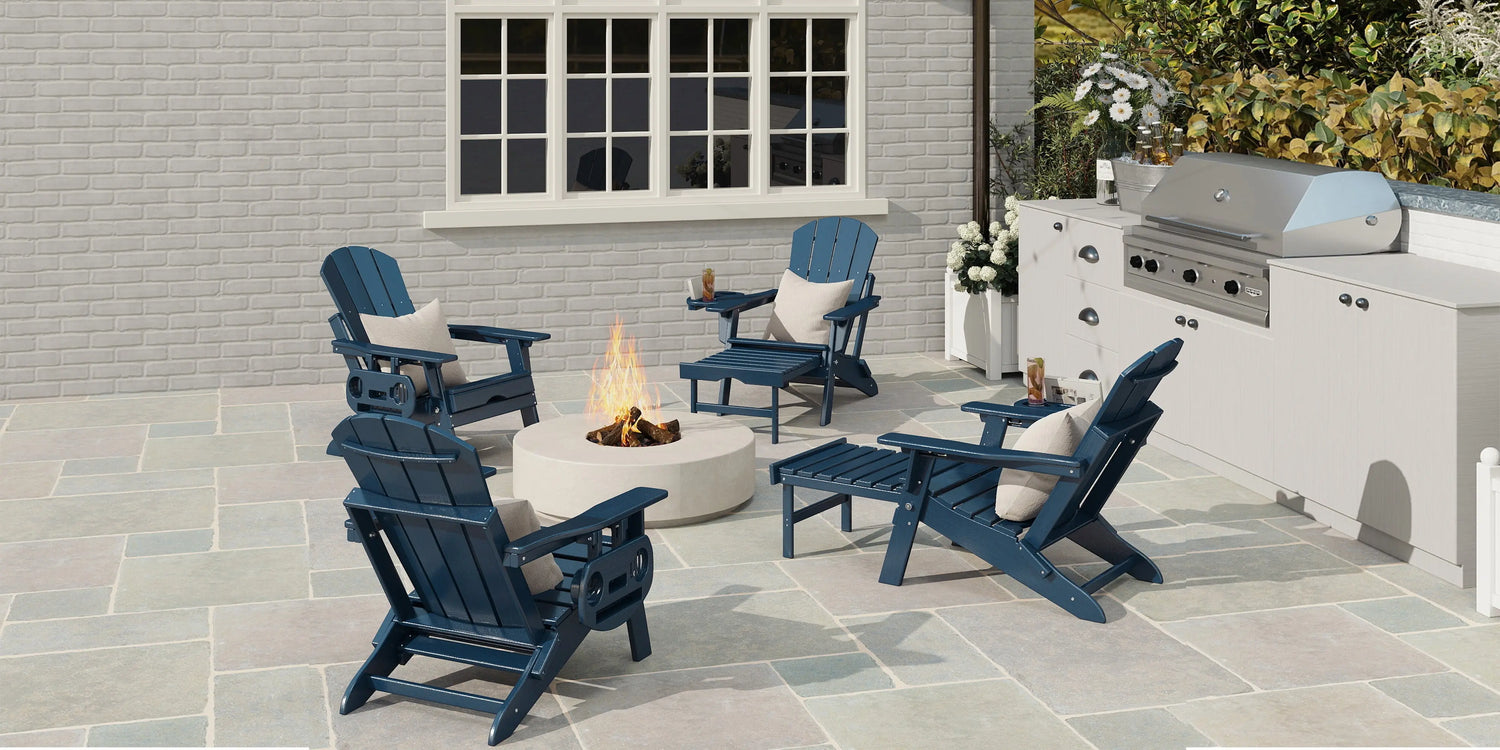
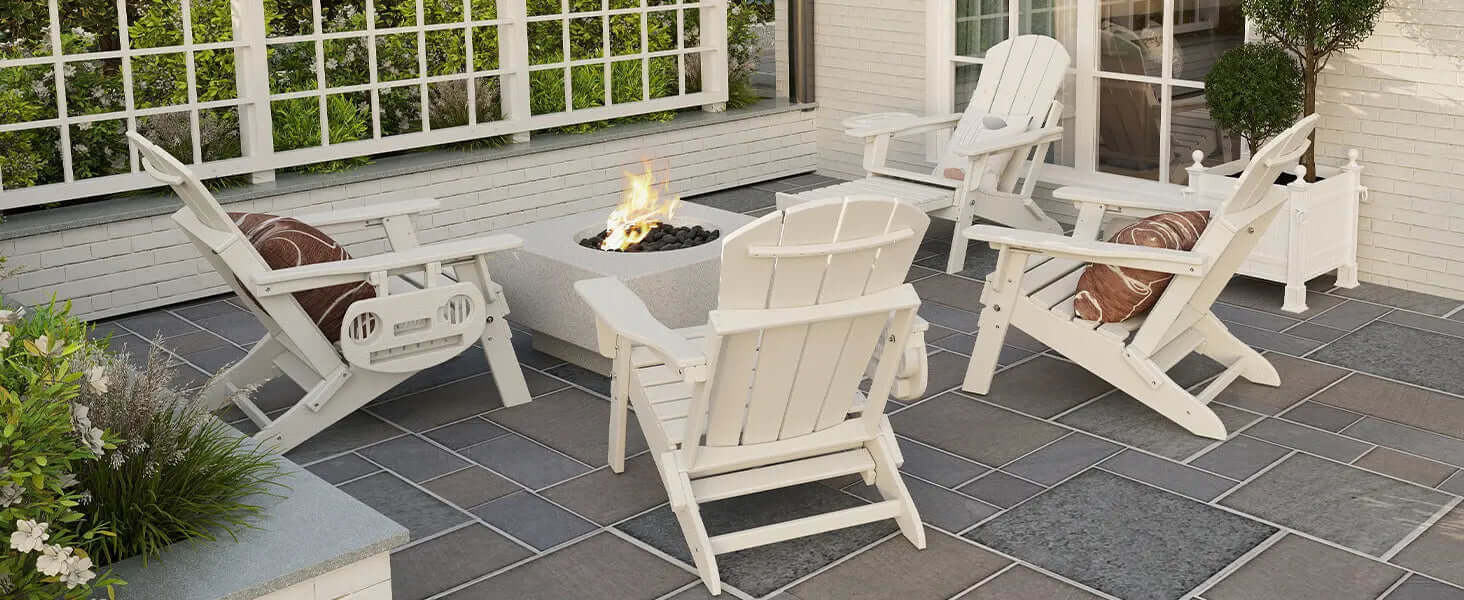
Let us take a single HDPE Adirondack chair as a case study. The Foowin Classic Folding Adirondack Chair retails for approximately $200. It comes with a 20-year warranty — not a "limited" warranty that covers only manufacturer defects while excluding UV fading and normal wear, but a genuine long-term guarantee that reflects what the material actually delivers.
Here is the annual cost breakdown:
- Purchase price: $200
- Expected lifespan: 20-25 years (conservative minimum)
- Annual cost: $10 per year or less
- Maintenance: $0 per year (hose it off occasionally)
- Covers/storage: $0 per year (stays outside year-round)
- Replacement: $0 (it will outlast your mortgage)
Compare that to a $50 budget plastic Adirondack chair:
- Purchase price: $50
- Expected lifespan: 2-3 years before cracking or fading to an ugly chalk-white
- Replacement cost over 20 years: $500 (10 replacements at $50 each)
- Annual cost: $25 per year for the chair alone
- Maintenance and covers: $15-20 per year
- Total annual cost: $40-45 per year

The $50 chair costs four times more per year than the $200 chair. That is not a paradox — it is the difference between buying a product and renting one. Every cheap chair is effectively a rental with a balloon payment due every 2-3 years.
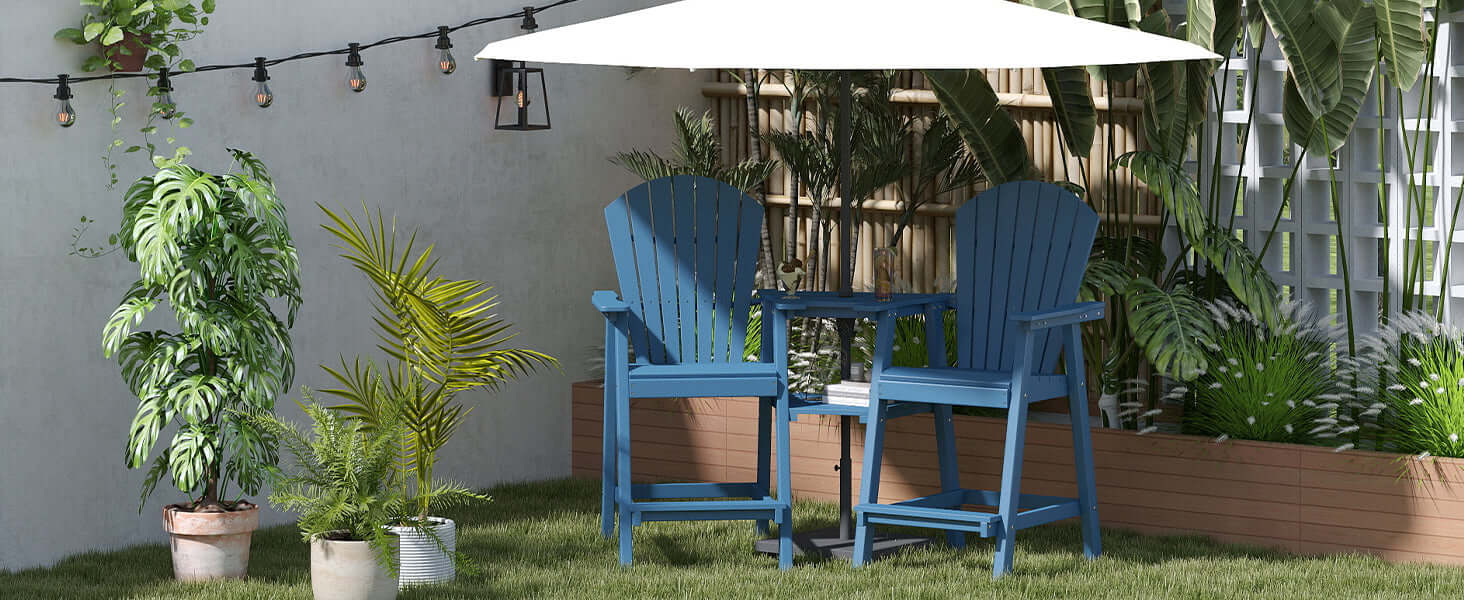
For a full dining or conversation set, the same math applies at scale. A Foowin HDPE Patio Dining Table Set is a one-time purchase that lasts decades — and the annual cost shrinks every year you own it. At $1,200 for a 6-person dining set with a 20-year lifespan, you are paying $60 per year for the entire setup. A comparable budget set, replaced every 3 years at $300 per replacement, costs $2,000 over the same period — $100 per year — and you spend those years on furniture that is deteriorating beneath you. The same logic applies to every category: Adirondack chairs, rockers, loungers, and bar sets — the annual cost of HDPE always beats the replacement treadmill.

For a deeper dive into the numbers, see our HDPE furniture cost vs value investment analysis, which breaks down the total cost of ownership across material types over 10, 15, and 20-year horizons.
When Budget Furniture Makes Sense
I am not going to tell you that budget furniture is always the wrong choice. There are specific scenarios where buying cheap is the rational decision:
Short-term staging. If you are selling your home and need patio furniture for the 90 days it is on the market, a $200 set from the big-box store is perfectly adequate. Buyers will not inspect the bolt metallurgy — they will see a furnished outdoor space and imagine themselves using it. Sell the set with the house or donate it after closing.
Temporary housing. If you are in a 6-month rental or a transitional living situation and do not want to move heavy furniture, cheap is fine. Just do not expect it to survive the move.
One-time events. A backyard wedding, a graduation party, a family reunion — these are one-day uses where furniture longevity is irrelevant. Rent if possible, buy cheap if rental is not available.
Testing a layout. If you are unsure how you want to arrange your patio and want to experiment with different configurations before committing to permanent HDPE pieces, a budget set can serve as a low-risk prototype. Just go in knowing it is a temporary tool, not a long-term solution.
For anything beyond 12-18 months of regular use, the math flips hard in favor of HDPE. The crossover point — where the cumulative cost of budget replacements exceeds the upfront cost of quality — typically arrives between Years 3 and 5. After that, every year you own cheap furniture is a year you are losing money. Whether it is an Adirondack chair, a dining set, or a rocking chair for the porch, the equation is the same: buy quality once, pay less forever.
For a detailed comparison of HDPE against wood and metal across all dimensions — cost, durability, maintenance, and appearance — read our HDPE vs wood vs metal comparison guide.
FAQ
How much does cheap outdoor furniture really cost over time?
A $200 budget patio set that needs replacing every 2 years costs $2,000 over 20 years in purchase costs alone — plus hidden costs like covers ($30-50/year), cleaning products ($25-40/year), replacement hardware, and the value of your time on assembly and maintenance. The all-in cost over 20 years typically exceeds $3,200. A $1,200 HDPE set lasting 20+ years with zero maintenance costs $1,200 total.
Is it better to buy cheap patio furniture and replace it often?
No. Replacing cheap patio furniture every 2-3 years costs significantly more over a decade than buying one quality HDPE set. Beyond the financial cost, the replacement cycle wastes your time, creates landfill waste, and means you spend more seasons sitting on deteriorating furniture than on comfortable, good-looking pieces.
How long does HDPE outdoor furniture last?
HDPE poly lumber typically lasts 20 to 25 years or more with essentially zero maintenance. Unlike wood, metal, or cheap plastic, HDPE does not rot, rust, crack, peel, or fade significantly. The color runs all the way through the material — it is not a surface coating — so scratches do not expose a different-colored core. Most quality HDPE furniture carries a 20-year manufacturer warranty reflecting real-world performance.
What are the hidden costs of cheap outdoor furniture?
Hidden costs of cheap outdoor furniture include: protective covers ($30-50 per piece, replaced every 2-3 years as covers themselves degrade), rust-removal and touch-up products ($20-40/year), seasonal storage space (garage square footage or storage unit fees), assembly and disassembly time (3-6 hours per season), replacement hardware like bolts and plastic feet, disposal fees for broken pieces, and the environmental cost of landfill waste from repeated replacements. Over a 20-year span, these hidden costs typically exceed the initial furniture purchase price several times over.
When does it make sense to buy budget outdoor furniture?
Budget outdoor furniture makes sense in four specific scenarios: staging a home for sale (90-day use), furnishing a temporary rental under 12 months, hosting a one-time event like a wedding or graduation party, and testing a patio layout before committing to permanent HDPE pieces. For any regular use beyond 12-18 months, the cumulative cost of cheap replacements overtakes the one-time cost of quality HDPE, making budget furniture more expensive from that point forward.
What is the annual cost of owning HDPE vs cheap plastic furniture?
A $200 HDPE Adirondack chair costs approximately $10 per year over its 20-year lifespan, with zero maintenance, cover, or storage costs. A $50 cheap plastic chair replaced every 2 years costs $25 per year for the chair alone, plus $15-20 per year in covers, cleaners, and hardware — totaling $40-45 per year. HDPE is roughly 4x cheaper on an annual basis. For a full dining set, a $1,200 HDPE setup ($60/year) beats a $300 budget set replaced every 3 years ($100/year plus hidden costs).

Mike Hartman
With over 20 years in outdoor construction and patio design, Mike has tested hundreds of outdoor furniture pieces in the brutal Texas sun. His philosophy: buy it once, maintain it never. When he is not writing, he is on his porch in Hill Country with a cold drink and a good book.
Read more from Mike →