

Outdoor Furniture Sets vs Individual Pieces: Which Saves More? (2026)
Last Updated at: Mike HartmanThe big-box store has a complete patio set for $899. Six chairs, a table, cushions, even an umbrella. It is displayed under string lights in the showroom, staged to look like a magazine spread. You pull out your phone, start adding up what the individual pieces would cost, and the math seems unbeatable. The bundle saves you almost $300 versus buying each item separately. So you buy it.
Twelve months later, two chairs have faded to an uneven gray. The coffee table surface is peeling at the edges. And when you try to find replacement cushions because a squirrel tore into one, the retailer has already rotated to next season's collection — the fabric pattern is gone forever.
This is the furniture set paradox: the upfront savings are real, but the long-term math tells a very different story. Let us break down exactly when a set saves you money and when buying individual pieces is the smarter financial decision.
Quick Answer
Quick Answer: Outdoor furniture sets save 15-30% upfront compared to buying the same pieces individually, making them the right choice if you are starting from an empty patio and every piece in the bundle meets your quality standards. Individual pieces cost more initially but give you total control over materials, let you replace one broken item without re-buying everything, and allow you to mix materials — like HDPE chairs with a wood table — for better durability where it matters. The smarter long-term play for most buyers: buy a quality core set for the main seating area, then add accent pieces individually over time.
The Economics of Furniture Sets: How Bundle Pricing Works
Retailers do not discount sets out of generosity. Bundle pricing is a margin strategy built on two principles: volume moves inventory faster, and the perceived discount anchors you to the purchase.
Here is how the numbers typically work. Suppose a manufacturer sells a six-piece dining set — four chairs, a table, and a bench — for $1,499. If you bought those pieces individually from the same collection, the chairs might run $180 each ($720), the table $500, and the bench $280, totaling $1,500. That looks like a negligible discount of one dollar. But the actual manufacturer cost to produce that set is about $450. The individual pricing is inflated to make the bundle look like a steal — a classic anchor-and-adjust tactic.
In the HDPE poly lumber space, the economics are slightly different because the material cost is higher and more consistent. A quality HDPE sofa set like the Foowin Outdoor Gardens Lounge Sofa Set will cost roughly the same whether you buy it as a set or add up the component prices — because HDPE manufacturing costs do not compress much at bundle scale. The savings come from shipping one pallet instead of four separate boxes, not from cheaper materials.
When Buying a Set Makes Perfect Sense
Sets are not a scam. In specific situations, they are genuinely the better choice.
You are furnishing a bare patio from zero. If you just finished a deck build or moved into a new home with an empty backyard, a set eliminates decision fatigue. You get proportions that someone already thought through — the table height matches the chair armrests, the bench tucks under the table, the cushions fit without measuring. This is worth real money in time saved.
The set is from a brand with consistent quality across all pieces. Some manufacturers — particularly in the HDPE and high-end teak categories — build every piece in a collection to the same standard. At Foowin, for example, the HDPE Patio Dining Table Set uses the same marine-grade stainless hardware and UV-stabilized poly lumber on the table, chairs, and bench. No bait-and-switch between the hero product and the supporting pieces.
You value visual cohesion above flexibility. A matched set creates a pulled-together look instantly. For short-term needs — staging a home for sale, furnishing a rental property, setting up a seasonal patio at a vacation house — the speed and simplicity of a set is hard to beat.
Shipping savings are significant. Freight on a single pallet with a complete set can run $150-250. Shipping four individual chairs, a table, and a bench as separate orders could easily double that. When furniture ships LTL freight rather than parcel, the bundled set wins every time.
When Individual Pieces Win
The case for buying individual pieces rests on three arguments: material optimization, replacement flexibility, and design freedom.
Material optimization. Different furniture functions demand different material strengths. Your dining chairs take the most abuse — people drag them across concrete, spill barbecue sauce on them, and leave them in full sun for years. They should be HDPE poly lumber or 304 stainless steel. But your side tables do not need the same material grade — a powder-coated aluminum accent table at half the price serves perfectly well. When you buy individually, you spend the material budget where durability matters and save on pieces that face less stress.
Replacement flexibility. This is the argument that nobody thinks about until they need it. Outdoor furniture breaks. Storms knock chairs into pools. Guests lean back too far. UV radiation eventually degrades even the best materials. With individual pieces, you replace one chair for $200 and keep the rest. With a matching set that is no longer in production, your options are: scour Facebook Marketplace for a discontinued model, accept a mismatched substitute, or replace the entire set. We will dig deeper into this in the replacement economics section below.
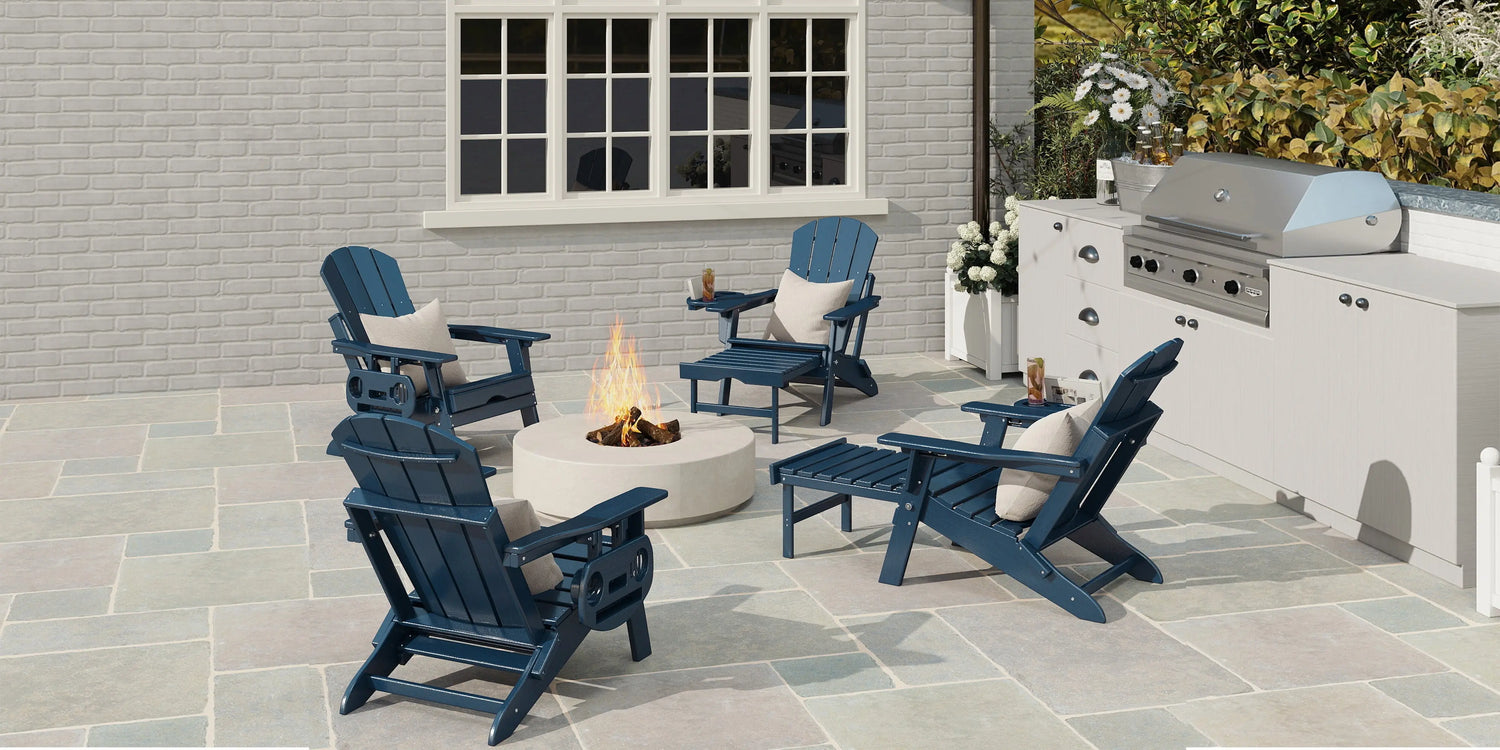
Design freedom. The most interesting patios I have seen do not look like a showroom floor. They mix a teak or concrete-top dining table with HDPE chairs in two different colors. They pair a classic Foowin Classic HDPE Adirondack Chair in navy with a rocking chair in a bright accent color. Individual buying lets you build a space that evolves with your taste instead of freezing it in one purchase decision made in a single afternoon.
Quality Trap: Why Sets Often Use Cheaper Materials
This is the section that might save you a thousand dollars. It is also the one most furniture retailers hope you skip.
The quality trap works like this: a set is marketed around its best-looking piece. The product page shows the sofa in high resolution with close-up shots of the weave pattern and cushion thickness. Then, buried in the "What's Included" list: "two armchairs, coffee table, two side tables." Those secondary pieces are where manufacturers cut costs.
Here are the specific downgrades I have seen repeatedly in big-box patio sets:
- Thinner-gauge frames on side chairs. The sofa has a 2mm aluminum frame; the matching chairs use 1.2mm. They look identical in photos. They do not feel identical when you sit in them, and they will not last the same number of seasons.
- Lower-density poly lumber on accent tables. The dining table uses high-density HDPE with UV inhibitors throughout the material. The matching side table uses lower-density poly that fades faster because UV stabilizers were applied only as a surface coating, not mixed into the polymer.
- Particle-board core tabletops with veneer. This is the worst offender. The set's main dining table is solid wood or poly lumber. The coffee table that comes "free" in the bundle has a particle-board core with a thin exterior. One rainstorm — even with a cover — and that table swells and delaminates.
- Cheaper cushion foam. The sofa cushions are high-resilience foam wrapped in Dacron. The chair cushions in the same set use standard poly foam that compresses within a season and holds water like a sponge.
The fix is simple: before buying any set, inspect every piece. Pull up the specifications for the side chairs, not just the sofa. Read the one-star reviews — not for the overall rating, but to see which specific pieces people are complaining about. If three reviews mention "coffee table warped after one season," the set's main pieces might be fine but the bundle economics have already turned against you.
Price Comparison: Set vs Individual — Real Numbers for 2026
Let us put actual dollars on this decision. Here is a realistic comparison for a mid-range patio dining setup — six seats plus a table — using current 2026 pricing.
Option A: Complete Dining Set
| Item | Price |
|---|---|
| Six-piece HDPE dining set (4 chairs, table, bench) | $1,799 |
| Shipping (single pallet, LTL freight) | $199 |
| Total | $1,998 |
Option B: Individual Pieces (Same Quality Tier)
| Item | Price |
|---|---|
| 4 HDPE dining chairs at $220 each | $880 |
| HDPE dining table | $599 |
| HDPE bench | $349 |
| Shipping (multiple packages) | $299 |
| Total | $2,127 |
The set saves about $130, or roughly 6%. That is the honest discount in the HDPE category — not the 30% you see advertised for big-box metal-and-wicker bundles. In high-end materials, bundles save on shipping and packaging, not on build quality. The margin compression is what it is.
Now here is the twist: let us say you buy the set. Two years in, one chair frame cracks (it happens — even HDPE can fail if a joint takes an unusual stress load). That exact chair has been discontinued. You now face three options: replace all four chairs for $880, live with a mismatched chair, or buy an entirely new set. The $130 you saved has now cost you $880.
Same scenario with individual pieces: you replace the one broken chair for $220. Done. The other three chairs, the table, and the bench are unaffected. You are still ahead by $660 compared to the forced four-chair replacement.
This is not hypothetical. I have watched neighbors go through exactly this math with big-box aluminum sets after a single storm season. The $300 upfront savings was wiped out three times over within 36 months.
The Flexibility Factor: Mixing HDPE Chairs with a Wood Table
One of the strongest arguments for individual buying is material pairing. Different outdoor materials have different strengths, and placing the right material in the right role extends the life of every piece.
HDPE chairs + wood table. Chairs take more abuse than any other piece of outdoor furniture. They are dragged, sat on wet, subject to uneven weight distribution, and constantly handled. HDPE poly lumber is perfect for chairs — it does not splinter, does not absorb water, and its color runs through the entire material so scratches are invisible. A wood table, by contrast, mostly just holds plates and drinks. It faces less mechanical stress and benefits from wood's natural warmth that HDPE cannot replicate. This pairing — HDPE chairs for durability, a stained teak or eucalyptus table for aesthetics — outperforms an all-HDPE or all-wood set on both fronts.

Mixed color palettes. When you buy a set, every chair is the same color. When you buy individually, you can put two navy Adirondacks on one side of the fire pit and two bright coral chairs on the other. It sounds minor, but that kind of deliberate color play is what separates a catalog patio from one that looks designed.

Gradual expansion. The best patios grow over years, not in a single Saturday shopping trip. Individual buying lets you add pieces as you identify needs — a side table next to the reading chair you use most, a bench where guests always end up sitting on the deck railing because there is not enough seating. Sets force you to buy everything at once, which often means you buy items you do not need and miss the ones you actually will use.
Replacement Economics: Break One Piece, What Happens Next?
Let us frame this with a concrete example that I have seen play out dozens of times in my 20 years of patio construction.
You buy a five-piece conversation set: two armchairs, a loveseat, a coffee table, and a side table. Total cost: $1,600. Three years later, the loveseat frame develops a crack at a stress joint. The manufacturer discontinued this collection 18 months ago — their product cycle runs two years, and you are on the wrong side of it.
Your options now:
- Find a used replacement on secondary markets. Expect to pay $200-350 for a used loveseat in your specific color, if you can find it. Time investment: weeks of searching Marketplace and Craigslist.
- Replace the loveseat with a similar-but-not-matching piece. Cost: $400-600. Your patio now looks like a college apartment — nothing matches, and the effect is accidental rather than intentional.
- Replace the entire set. Cost: another $1,600. You throw away four perfectly good pieces because one failed. The environmental waste alone should make you pause.
- Sell the remaining pieces individually and start over. You might recover $400-500 on Marketplace. Net loss: $1,100 plus the new set cost.
Now re-run the scenario with individually bought pieces. You paid $2,000 total — $400 per armchair, $700 for the loveseat, $300 for the coffee table, $200 for the side table. The loveseat fails after three years. You replace just the loveseat with a new model for $700. Total outlay: $2,700 over three years. In the set scenario, replacing everything costs $3,200 ($1,600 original + $1,600 new set) — and that is the best-case option where you actually replace everything rather than living with a broken centerpiece on your patio for two summers while you debate what to do.
The replacement math is brutal and it always favors individual buying. The only way the set wins is if nothing ever breaks — and outdoor furniture, subjected to UV, rain, wind, and human use, breaks more often than anyone wants to admit.
Frequently Asked Questions
Is it cheaper to buy outdoor furniture as a set or individually?
Sets are typically 15-30% cheaper than buying the same pieces individually because retailers bundle items at a discount. A $1,200 set might cost $1,550 if you bought each piece separately. However, the savings only hold if you actually need every piece in the set. If you end up replacing two chairs from a six-piece set within two years, your bundle savings evaporate. In higher-end material categories like HDPE poly lumber, the set discount is smaller — often 5-10% — because material costs do not compress much at bundle scale. The real savings in premium furniture sets come from consolidated shipping, not from cheaper manufacturing.
What are the disadvantages of buying furniture sets?
The main disadvantages are limited design flexibility, potential quality compromises on secondary pieces, and replacement headaches. Sets lock you into one material and style across all pieces. You cannot mix a teak table with HDPE chairs unless you buy separately. Some sets also use lower-grade materials on accent pieces like side tables — thinner aluminum, lower-density poly lumber, or veneered particle board instead of solid construction. And if one chair breaks, matching it three years later is nearly impossible since retailers rotate collections annually. You are stuck with either a mismatched piece or the cost of replacing everything.
Can you mix and match outdoor furniture from different sets?
Yes, and mixing materials and styles often creates more visually interesting patios than matching sets. A wood dining table with HDPE poly lumber chairs is a popular combination that balances warmth with durability. The key to mixing successfully is maintaining a consistent color palette or design through-line — such as matching cushion colors or sticking to one metal finish across pieces. Even small anchors like consistent pillow colors or rug patterns can tie disparate furniture into a unified look. For more on mixing strategies, see our guide to outdoor dining and entertaining furniture.
Do outdoor furniture sets use lower quality materials?
Not always, but it is a common issue. Big-box store sets frequently cut corners on side chairs and accent tables — using thinner-gauge aluminum, lower-density HDPE, or particle-board tabletops while advertising the set based on the best piece. The sofa might be solid but the coffee table warps within a season. When buying a set, inspect every piece individually rather than judging by the hero product. Read reviews for the specific components, not just the set as a whole. Higher-end brands — particularly in the HDPE category — maintain consistent material standards across all pieces, but verification is always worth the effort. For a deeper dive into material quality, check our HDPE cost vs value investment analysis.
What happens if one piece in a set breaks?
This is the biggest hidden cost of furniture sets. Retailers rotate collections annually, so finding an exact replacement two or three years later is extremely difficult. Your options narrow to: hunting for a used match on secondary markets (time-consuming and uncertain), replacing the broken piece with a similar-but-not-matching substitute (compromises the visual cohesion you paid for), or replacing the entire set (financially wasteful). With individual pieces, you simply replace the broken item and keep everything else — no visual disruption, no forced re-buy. The math is stark: a $220 replacement chair versus potentially replacing $1,800 worth of furniture because one component failed.
Should I buy a patio set or build my own collection?
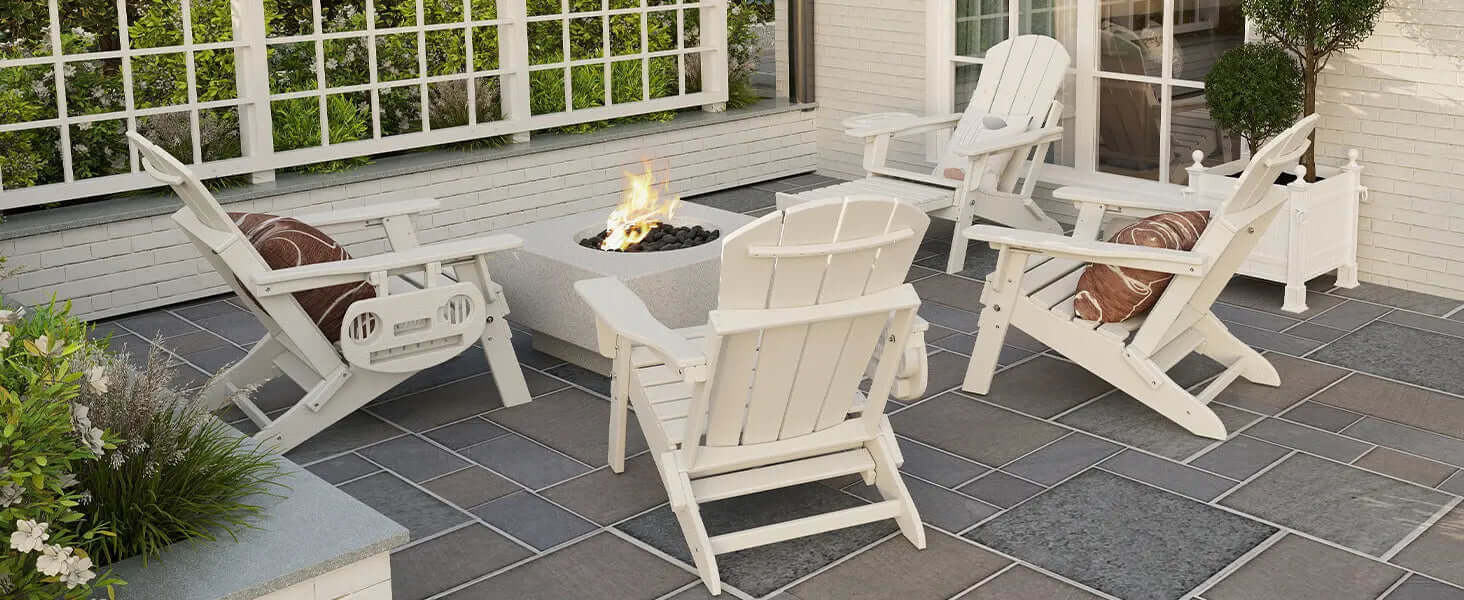
Buy a set if you are furnishing a space from scratch, need a cohesive look immediately, and have verified that every piece in the bundle meets your quality standards. Sets are also the right call for rental properties, staging, and situations where time matters more than long-term flexibility. Build your own collection if you have an existing piece to work around, want to mix materials for durability and style, or plan to add pieces gradually over time. The best approach for many homeowners is a hybrid: buy a core dining set or conversation set from a quality manufacturer, then add individual accent pieces — rocking chairs, side tables, a fire pit seating group — separately as your needs evolve. This captures the set's upfront savings on the biggest-ticket items while preserving the flexibility to customize everything else.
Related Articles
- HDPE Furniture Cost vs Value: A Complete Investment Analysis — The numbers behind why HDPE costs more upfront but costs less over 10 years
- Best Outdoor Patio Chairs: The Complete 2026 Buying Guide — Compare chair types, materials, and find the right seat for your space
- Outdoor Dining and Entertaining Furniture Guide — Build a patio setup that works for everyday meals and weekend gatherings

Mike Hartman
With over 20 years in outdoor construction and patio design, Mike has tested hundreds of outdoor furniture pieces in the brutal Texas sun. His philosophy: buy it once, maintain it never. When he is not writing, he is on his porch in Hill Country with a cold drink and a good book.
Read more from Mike →